Home » Wallcovering & Wallpaper Installation » Best wallcoverings for high ceilings Colorado
High ceilings can transform an ordinary room into a dramatic architectural space. In Colorado homes, vaulted living rooms, two-story entryways, tall staircases, and open-concept interiors often feature walls reaching 12, 16, or even 20 feet above the floor.
These spaces offer exciting design opportunities, but they also introduce challenges that homeowners may not anticipate.
Installing wallpaper on a 20-foot wall is not simply twice the work of installing it on a 10-foot wall. Longer panels become heavier, require more careful handling, and can be significantly harder to align. Specialized equipment, additional installers, and longer preparation times may also be necessary.
At Enjoy The Wall, our experience with high-ceiling projects throughout Colorado has shown that ceiling height affects nearly every stage of installation, from material selection to equipment planning.
For homeowners considering professional wallpaper installation in the Denver metro area, understanding these differences early can help prevent unexpected expenses and make the finished project more successful.
One of the most common misunderstandings about high-ceiling wallpaper installation concerns pricing.
Homeowners frequently assume that installation costs should increase in direct proportion to the square footage being covered. In practice, the relationship is more complicated.
Height changes not only the amount of material being installed but also the physical difficulty of working with it.
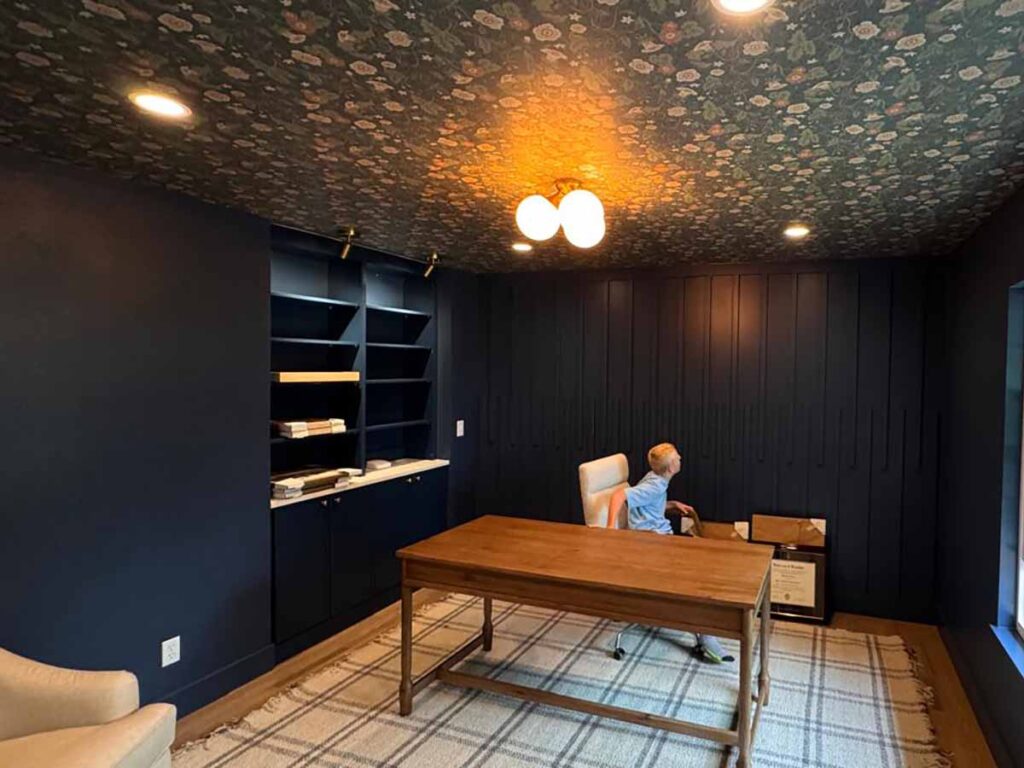
An 8-foot ceiling is a typical residential height and generally provides relatively straightforward working conditions.
Installers can often work with standard professional ladders or appropriate low-level platforms. Wallpaper panels are manageable, and most surfaces can be reached without specialized access equipment.
Material characteristics, wall condition, pattern complexity, and architectural obstacles still influence pricing, but height itself is usually not the primary challenge.
At 10 feet, installation becomes more demanding.
Longer strips require greater control during positioning and smoothing. Installers may need additional ladder repositioning, and working above shoulder height becomes a larger part of the project.
Even when wall preparation is minimal, the additional handling and access requirements can increase labor costs.
At 12 feet, the difference becomes much more noticeable.
Wallpaper panels are longer, more difficult to control, and potentially heavier. Maintaining alignment while working at different elevations takes additional time.
Depending on the room and material, specialized platforms or other access arrangements may be necessary.
A 12-foot wall is not automatically suitable for the same installation approach used on an 8-foot wall.
Once wall heights exceed approximately 12 feet, equipment planning becomes a major part of the project.
Scaffolding, suitable lifts, or specialized work platforms may be required, depending on the room geometry and available floor space.
The cost of transporting, assembling, repositioning, and removing this equipment can be substantial.
This is why a 20-foot wallpaper installation may cost disproportionately more than a standard-height project, even after accounting for the greater wall area.
A wallpaper strip measuring 8 feet behaves very differently from one measuring 18 or 20 feet.
The difference becomes especially apparent with heavy vinyl wallcoverings, large pattern repeats, and materials that require adhesive application.
A longer strip contains more material and therefore weighs more.
With heavier vinyl products, this additional weight can make positioning particularly difficult.
If the installation method requires adhesive on the back of the wallcovering, the adhesive also adds weight. More material means a larger surface area to coat and handle.
The installer must keep the panel properly supported while preventing folds, unwanted stretching, contamination, or damage.
Some materials require multiple installers to handle a long panel safely and maintain control throughout placement.
Once a long strip is positioned, it must be smoothed consistently.
Air pockets, adhesive distribution, surface irregularities, and alignment all require attention.
The installer must work methodically without allowing the remaining length of material to shift or place excessive tension on the upper section.
Materials differ in how much manipulation they tolerate. Some allow careful repositioning, while others are more sensitive to handling.
Long walls amplify layout problems.
A small alignment error near the top can become increasingly apparent as the installation progresses downward.
Architectural details, wall irregularities, and pattern repeats can make this even more challenging.
For this reason, measuring and planning the installation sequence is especially important before the first strip is applied.
Working at height requires more than a long ladder.
At Enjoy The Wall, our team evaluates access conditions before determining the installation approach. The appropriate equipment depends on ceiling height, room dimensions, floor conditions, material requirements, and the work being performed.
Ladders may be suitable for certain installations reaching approximately 12–14 feet, depending on the task and available working conditions.
However, they are not appropriate for every wall or material.
Installing long, heavy wallpaper panels requires continuous control and sufficient room to work. A ladder that reaches the necessary elevation does not necessarily provide an adequate working platform.
The final access method must comply with equipment requirements and applicable safety standards.
Scaffolding often becomes practical for walls above approximately 12 feet.
It can provide a more stable working position and allows installers to access a larger section of the wall.
However, scaffolding introduces additional project costs that homeowners do not always consider:
Transportation to and from the property
Delivery access and unloading
Assembly and inspection
Protection of floors and surrounding finishes
Repositioning during installation
Disassembly and removal
These activities require time even before wallpaper installation begins.
In suitable rooms, a sufficiently wide lift or elevated work platform may offer an efficient way to access very tall walls.
The equipment must accommodate the installation process, including the safe handling of long wallpaper panels.
Floor loading capacity, door clearances, room dimensions, and protection of existing finishes must also be considered.
A lift that works well in a large open living room may be unsuitable for a narrow hallway or staircase.
High stairwells are among the most challenging residential installation environments.
The floor is stepped or sloped, access is limited, and there may be little room for conventional scaffolding or lifts.
Specialized stairwell platforms or appropriately designed access systems may be required.
The difficulty comes not only from reaching the surface but also from safely positioning and handling long panels above a staircase.
This type of installation should be evaluated individually rather than priced as a conventional flat wall.
Wallpapering a tall wall and wallpapering a ceiling 20 feet above the floor are two very different operations.
Ceiling installation requires installers to control the material overhead while aligning, adhering, and smoothing it.
At substantial heights, this becomes a particularly demanding process.
For a ceiling approximately 20 feet high, a properly designed scaffold platform covering the necessary working area may be required to provide continuous access.
A small platform that must constantly be moved may not allow installers to maintain safe, consistent control of long overhead strips.
The project must also account for lighting fixtures, ceiling geometry, adhesive requirements, panel direction, and material weight.
Heavy wallcoverings may not be approved for overhead installation at all. Manufacturer instructions and product suitability must be reviewed before specifying the finish.
The access equipment and installation plan can become a major part of the total project cost.
There is no single wallcovering that is universally best for every high-ceiling space.
The ideal material depends on the design, substrate condition, desired texture, lighting, budget, and manufacturer requirements.
At Enjoy The Wall, our role is not to replace the interior designer’s vision. We help determine how the selected material can be installed successfully and whether an alternative substrate or product could achieve the desired appearance with less preparation or installation difficulty.
Non-woven wallcoverings are a practical option for many residential installations.
They are often dimensionally stable and available in a wide range of textures, colors, and designs.
Depending on the product, non-woven wallpaper may be easier to handle than some traditional paper materials.
However, not every non-woven wallpaper has the same thickness or surface characteristics.
Thin, smooth products can reveal wall imperfections, particularly when strong natural or directional lighting highlights the surface.
Heavier, textured non-woven products may help visually minimize minor irregularities, but this does not eliminate the need for a sound, properly prepared substrate.
Vinyl wallcoverings can be attractive for large walls because many products offer durability, texture, and resistance to everyday wear.
Some heavier or embossed vinyl products can visually disguise slight imperfections that might show through thinner materials.
However, their weight becomes a significant consideration in tall installations.
A long vinyl panel can be difficult to support, position, smooth, and align.
Consequently, choosing a heavier material to reduce certain wall preparation requirements does not automatically reduce the total project cost.
The savings in preparation must be evaluated against potential increases in installation labor and equipment requirements.
Natural grasscloth can create a distinctive, sophisticated finish in large entryways, living rooms, and other high-ceiling interiors.
Its organic texture works particularly well in spaces where the design emphasizes natural materials.
However, grasscloth requires realistic expectations.
Visible seams, natural color variations, and differences between panels may be inherent characteristics of the product rather than installation defects.
These effects can become especially noticeable across large uninterrupted walls.
Natural materials may also require delicate handling, specific adhesives, and protection from moisture or surface contamination.
Custom murals offer another approach to dramatic high walls.
Instead of repeating a small pattern, a mural can create a complete visual composition designed around the architecture of the room.
Tall walls in entryways, staircases, and living rooms can provide an impressive setting for botanical artwork, landscapes, abstract designs, or architectural graphics.
However, murals require accurate measurements and careful planning.
If the panels are manufactured to specific dimensions, incorrect measurements or installation errors may be difficult or impossible to correct without replacement material.
Wallpaper is not the only option for a high-ceiling feature wall.
Decorative plaster, limewash, and concrete-inspired finishes can create continuous surfaces without conventional wallpaper seams.
These finishes are particularly effective where an interior designer wants subtle texture, depth, and a unified appearance across a very large wall.
At Enjoy The Wall, we also provide decorative plaster and specialty wall finishes, allowing clients to compare different finishing approaches.
However, seamless appearance does not mean that application is simpler. Tall plaster walls require appropriate access equipment, careful surface preparation, and coordinated application to maintain consistent texture and color.
The choice should follow the intended design rather than an assumption that one finish is always better.
Sometimes, but the answer depends on the type and condition of the existing wall.
One of the practical lessons from our installation experience is that wall preparation and material selection should be considered together.
A homeowner may be able to achieve the desired appearance more economically by selecting a material that is less likely to highlight minor imperfections.
Certain heavy vinyl and textured non-woven wallcoverings can make small surface irregularities less noticeable.
For example, a wall with minor cosmetic unevenness may not require the same level of finishing as a wall intended for very thin, smooth, or reflective wallpaper.
Kris A. and the Enjoy The Wall installation team evaluate these trade-offs when helping clients select materials.
The goal is to avoid unnecessary preparation where appropriate without compromising adhesion, appearance, or the manufacturer’s requirements.
Significant surface texture cannot simply be concealed with heavier wallpaper.
Popcorn-like wall texture, deep irregularities, loose coatings, damaged drywall, and unstable surfaces generally require correction.
Applying wallpaper directly over these conditions can produce poor adhesion, visible defects, and premature failure.
In many cases, the wall must be skim-coated, sanded, and properly primed before installation.
Our wallpaper removal and wall preparation services address these conditions based on the selected finish and existing substrate.
Trying to avoid necessary preparation can lead to problems that cost far more to correct later.
On a high wall, replacement work may require bringing back the same scaffolding or lift used during the original installation.
That means another round of transportation, setup, labor, material removal, surface correction, and installation.
Proper evaluation before installation is particularly valuable when access costs are substantial.
Peel-and-stick wallpaper is frequently marketed as a simple, fast, and affordable alternative to traditional wallcoverings.
The appeal is understandable. No separate wallpaper paste is required, and many products are advertised as suitable for DIY installation.
However, our experience at Enjoy The Wall suggests that the installation process can be far more complicated than homeowners expect.
Many peel-and-stick products are thin and have limited ability to conceal irregularities.
Bumps, depressions, uneven drywall, and residual wall texture can become visible after application.
Some products also have limited tolerance for repositioning or manipulation once the adhesive contacts the wall.
Their behavior varies by manufacturer, but these characteristics can make precision installation especially difficult on long walls.
Peel-and-stick products rely on pressure-sensitive adhesive systems.
Performance depends on the specific product, surface preparation, paint condition, curing time, and environmental conditions.
Temperature changes can affect some removable adhesive systems, making product suitability especially important in rooms exposed to large temperature fluctuations.
A material marketed as removable or easy to install is not necessarily suitable for overhead applications or long-term use in every interior.
Installing peel-and-stick wallpaper overhead adds another level of difficulty.
The installer must control the panel, remove or manage the backing, maintain accurate alignment, and apply consistent pressure while working above the head.
Long panels may fold, adhere to themselves, or make accurate positioning difficult.
For high ceilings, these challenges are magnified by limited access and the need to manage the material safely from an elevated working platform.
We generally discourage using typical consumer peel-and-stick products for demanding high-ceiling projects unless the specific product is approved for the application and the installation conditions are appropriate.
At Enjoy The Wall, we have received hundreds of inquiries from homeowners seeking help after struggling to install peel-and-stick wallpaper themselves.
Many initially chose the material because it appeared inexpensive and easy to apply.
They were then surprised to discover that professional installation could cost more than the wallpaper itself.
This is particularly true when the surface requires extensive preparation or the geometry makes installation difficult.
Our team is selective about accepting these projects because material limitations can make it difficult to achieve the durable, refined result clients expect.
We generally recommend established manufacturers and conventional wallcovering systems for permanent residential interiors, particularly where the installation is expensive or difficult to access.
Peel-and-stick can still be appropriate for temporary installations, short-term exhibitions, seasonal designs, or spaces where easy replacement is more important than long-term durability.
For a permanent feature wall extending 20 feet above the floor, however, we believe material longevity should be part of the decision from the beginning.
High ceilings offer opportunities to emphasize architecture without covering every wall.
In many homes, a single carefully selected feature wall provides a stronger visual result than applying wallpaper throughout the entire room.
Tall living room walls can become a central design element.
Large-scale murals, textured wallcoverings, natural fibers, and decorative plaster can highlight the room’s vertical proportions.
The appropriate pattern scale should be considered from normal viewing positions rather than only from close-up samples.
Two-story entryways are often among the most visually prominent spaces in a home.
A well-chosen wallcovering can complement staircases, lighting fixtures, architectural trim, and adjacent rooms.
However, access arrangements should be evaluated before the material is ordered.
Staircases offer dramatic vertical surfaces but can be difficult to access.
Pattern alignment, sloping transitions, landings, and limited equipment space all influence installation.
In some cases, the access conditions may have a greater impact on labor costs than the selected wallcovering itself.
A feature wall behind a bed can create visual balance in rooms with unusually high ceilings.
Textured non-woven wallpaper, fabric-like finishes, and selected designer collections can provide a sophisticated appearance without overwhelming the space.
The design should also account for windows, wall sconces, headboards, and other architectural elements.

Established manufacturers offer a wide range of products suitable for different interior applications.
At Enjoy The Wall, we work with collections from Phillip Jeffries, York, Thibaut, Schumacher, Milton & King, Graham & Brown, and other recognized wallcovering manufacturers.
However, a respected brand name alone does not determine whether a material is appropriate for a 20-foot wall.
We evaluate the actual product, including its thickness, backing, dimensions, pattern repeat, adhesive requirements, and installation instructions.
For high-ceiling projects, material availability and correct quantity calculations are also particularly important.
Replacing a damaged or incorrectly cut long panel can consume a substantial amount of additional material.
Clients can explore our designer wallpaper brands and sourcing services to compare collections and receive guidance before ordering.
Colorado’s dry climate and seasonal temperature variations introduce considerations that should not be ignored.
The main concern is not simply that a home is located in Colorado. It is whether indoor conditions meet the requirements of the chosen wallcovering, adhesive, and substrate.
During winter, indoor heating can reduce relative humidity.
Material handling, adhesive open time, and drying behavior can be affected by environmental conditions.
Installers should follow manufacturer specifications and maintain appropriate indoor conditions during application and curing.
Many Colorado homes feature large windows and substantial natural light.
Direct sunlight can reveal surface irregularities, accentuate seams, and contribute to color changes in some materials over time.
Products should be evaluated for their intended exposure, and samples should ideally be reviewed under the room’s actual lighting conditions.
Rooms should not be excessively cold, overheated, or exposed to dramatic temperature changes during installation and curing.
High-ceiling spaces may also have temperature differences between floor level and upper walls.
These conditions are worth considering when scheduling a project, particularly in winter or during major renovations when HVAC operation may be inconsistent.
High-ceiling wallpaper installation should begin with an evaluation of the entire room, not simply a wall measurement.
Before purchasing materials or scheduling installation, the following factors should be reviewed:
Actual wall and ceiling heights. Measure the entire installation area, including sloped or vaulted sections.
Access conditions. Identify whether ladders, scaffolding, lifts, or specialized platforms are necessary.
Material characteristics. Consider panel weight, width, backing, pattern repeat, and manufacturer requirements.
Surface condition. Determine whether repairs, skim coating, sanding, or specialized primers are needed.
Material quantities. Account for panel lengths, pattern matching, waste, and possible replacement needs.
Room protection. Plan how floors, stairs, railings, furniture, and fixtures will be protected.
Installation conditions. Maintain suitable temperature and humidity during installation and curing.
For larger projects, coordination between the interior designer, general contractor, material supplier, and installer can prevent expensive changes after materials arrive.
High-ceiling wallpaper projects raise questions that rarely come up during standard residential installations. The answers below reflect common concerns we encounter while planning wallcovering projects throughout Colorado.
Usually, yes. Twelve-foot walls generally require more demanding installation methods than standard 8-foot walls.
Longer panels, increased handling difficulty, and additional access requirements can increase labor costs. The exact difference depends on material weight, pattern complexity, room geometry, and equipment needs.
There is no reliable universal percentage. The cost can increase disproportionately compared with standard-height installation.
A 20-foot wall may require scaffolding, lifts, multiple installers, additional material handling, and longer setup time.
The total estimate should include both wallpaper installation and the equipment required to complete the work safely.
Ladders are generally not the preferred solution for installing long wallpaper panels at that height.
Wallpaper installation requires controlled handling, alignment, and smoothing. Suitable scaffolding or work platforms often provide more practical working conditions.
The appropriate method depends on the work area, equipment specifications, and applicable safety requirements.
There is no single best material. Non-woven wallpaper, selected vinyl wallcoverings, natural fibers, murals, and specialty finishes can all be appropriate.
The final choice depends on the intended appearance, existing surface, panel weight, installation access, and manufacturer instructions.
Consulting an experienced installer before ordering can help identify avoidable technical problems.
Not necessarily. Heavier vinyl may conceal minor cosmetic surface irregularities, but its additional weight can make long panels harder to handle.
Any reduction in preparation requirements must be balanced against installation complexity.
A heavier product is not automatically a cheaper or easier choice.
Generally, no. Pronounced popcorn or heavily textured surfaces usually require correction before wallpaper installation.
Even thick wallcoverings need a stable substrate that meets the manufacturer’s requirements.
Skim coating, smoothing, and priming may be necessary to achieve an appropriate installation surface.
Only when the specific product is suitable for overhead application and the installation conditions are appropriate.
Many consumer peel-and-stick materials are difficult to handle over large overhead surfaces and require extremely consistent substrate preparation.
For permanent high-ceiling installations, we generally recommend evaluating conventional wallcovering systems first.
Material price and installation difficulty are separate considerations.
Thin pressure-sensitive products can require extensive wall preparation, careful alignment, and significant labor.
A low purchase price does not necessarily mean the product will be inexpensive to install professionally.
They can be a good alternative when a seamless appearance is the design priority.
Limewash, decorative plaster, and concrete-inspired finishes offer textures without conventional wallpaper panel seams.
However, they also require skilled application, surface preparation, and appropriate working platforms. The better choice depends on the design and project conditions.
Yes, subject to an assessment of access and project conditions.
Enjoy The Wall works with complex architectural surfaces, including high walls and staircases.
Narrow stairwells may require specialized platforms because conventional lifts or scaffolding cannot always be accommodated.
For high-ceiling projects, we recommend consulting the installer first.
Material width, pattern repeat, usable roll length, and access conditions can affect the quantity required and installation cost.
Early consultation can help avoid ordering a product that is unsuitable for the surface or unnecessarily difficult to install.
Yes. We work with homeowners, interior designers, architects, builders, and general contractors to evaluate materials and source selected wallcoverings.
Our role includes assessing installation requirements, recommending suitable preparation, reviewing material quantities, and completing the installation.
Tell us about your high-ceiling project and include the approximate wall height, location, selected material if available, and photographs of the space.
These details help us assess installation access, preparation needs, and the next steps.
+1 (720) 825-7157
Proudly working with clients statewide.
Planning a wallpaper or decorative wall-finishing project in a home with 10-, 12-, 16-, or 20-foot ceilings?
Enjoy The Wall provides professional installation for high walls, vaulted spaces, staircases, feature walls, and other challenging interiors throughout the Denver metro area and selected locations across Colorado.
Our team, led by Kris A., evaluates material requirements, wall preparation, installation access, and project conditions before recommending an installation approach.
If you already have an interior designer or a selected wallcovering, we can work with the existing design and help develop a practical installation plan.
We can also assist with sourcing wallcoverings from established manufacturers when material selection is still in progress.
Explore Wallpaper & Wallcovering Services · All Services
For Interior Designers, Architects & Builders · View Recent Projects

Find wallpaper, decorative plaster, brands, guides, FAQs and blog articles.