
Home » Wallcovering & Wallpaper Installation » Peel and Stick vs Real Wallpaper in the Denver Metro Area
Peel-and-stick wallpaper is usually sold with a very attractive promise: no paste, no complicated installation, lower material cost, and an easy DIY project.
After installing peel-and-stick wallcoverings in real Colorado homes, our experience has been much less simple.
At Enjoy The Wall, we have installed peel-and-stick products ourselves. We have also been called into homes after clients tried to install two or three panels and decided they could not continue. In other cases, we have installed the material on walls prepared to an exceptionally high standard, only to see adhesion problems develop later.
That does not mean peel and stick can never work.
It can.
But based on our installation experience, it is one of the least forgiving wallcovering systems we work with.
In Denver-area homes, where textured drywall, imperfect wall geometry, strong sunlight, dry indoor air, and significant temperature changes are common, those limitations become especially important.
The biggest misconception is that peel and stick is the easy option.
In many projects, it is exactly the opposite.
When homeowners compare peel-and-stick wallpaper with traditional wallpaper, they often compare only two things: the price of the material and whether paste is required.
From an installer’s perspective, that comparison misses most of what determines whether a wallcovering project succeeds.
The wall condition, wall texture, primer, material thickness, backing, adhesive system, room geometry, sunlight, temperature, pattern repeat, and installation method can all affect the finished result.
For homeowners planning a permanent wallcovering project, our professional wallpaper installation in the Denver Metro area is built around those variables rather than treating every wallpaper material as the same product.
Traditional wallpaper gives an installer considerably more control over many of those variables.
Peel and stick gives us much less.
That difference is at the center of almost every issue discussed below.
Peel-and-stick wallpaper is a self-adhesive wallcovering with an adhesive layer already applied to the back.
The installer removes the protective backing and presses the material directly onto the wall. There is no separate wallpaper paste.
That sounds simple.
But eliminating paste removes only one part of wallpaper installation.
The installer still has to keep long panels straight, maintain the pattern match, control seams, work through inside and outside corners, trim around ceilings and baseboards, work around outlets and windows, and compensate for walls and ceilings that are rarely perfectly square.
The material also has to remain attached to the wall long after installation day.
That is where peel and stick becomes much more complicated than the packaging often suggests.
Enjoy The Wall does install this category of material, and clients who have already selected a product can review our peel-and-stick wallpaper installation service before scheduling a project.
Traditional wallcoverings include non-woven wallpaper, paper-backed products, vinyl, grasscloth, textile wallcoverings, murals, and other materials installed with a separate adhesive system.
The exact installation method depends on the product and manufacturer requirements, but a professional installation may include wall repair, skim coating where necessary, sanding, primer, and an adhesive selected for the specific material and substrate.
That creates a fundamentally different installation system.
With peel and stick, the installer is largely dependent on the adhesive supplied with the product.
With traditional wallpaper, the wall, primer, adhesive, backing, and wallcovering can work together as a coordinated system.
For permanent installations, that additional control is extremely important.
Clients comparing materials can also review our designer wallpaper installation and sourcing service, especially when the wallcovering has not yet been purchased.
Many peel-and-stick products are comparatively thin.
That thin construction can make them much less forgiving of wall irregularities than wallcoverings with a more substantial backing.
A wall may look perfectly acceptable when painted and still be far from flat enough for thin wallcovering.
In real homes, we regularly encounter:
subtle waves in drywall;
previous patches and repairs;
uneven skim coating;
orange-peel texture;
imperfect inside and outside corners;
walls that are not plumb;
ceilings that are not level;
irregular areas around windows and doors.
Paint can visually hide many of these conditions.
Wallpaper cannot.
A thin self-adhesive material tends to follow the wall very closely, revealing surface defects and making alignment more difficult.
Traditional non-woven, vinyl, textile, grasscloth, and other wallcoverings vary significantly in construction, but many have a more substantial backing or body.
That additional structure can make the material more manageable during installation and more forgiving of small imperfections in the wall.
One of the biggest challenges we see throughout the Denver metro area is wall texture.
Orange peel and other sprayed drywall textures are extremely common.
For peel and stick, this can be a major problem because adhesion depends heavily on surface contact.
On a textured wall, the material first contacts the high points while small valleys remain underneath.
The homeowner may see a wall that looks relatively smooth from across the room.
The wallpaper sees a completely different surface.
This is where many homeowners get surprised.
They purchase inexpensive peel-and-stick wallpaper expecting an inexpensive project.
Then we evaluate the wall.
If the wall has texture, irregularities, previous repairs, or other defects, achieving the best possible installation may require extensive preparation.
That may include:
skim coating;
patching;
sanding;
surface correction;
cleaning;
priming where required;
sufficient curing time before installation.
The wall preparation can cost significantly more than the wallpaper itself.
That is why the material price alone is a poor way to compare wallcovering systems.
The better question is:
What will the complete wall cost once the surface has been prepared correctly and the material has been professionally installed?
This is one of the biggest contradictions we see with peel and stick.
The product is often selected specifically because it appears inexpensive.
But the material may require an exceptionally smooth surface to perform and look its best.
That means a relatively inexpensive roll can end up sitting on top of one of the most labor-intensive wall preparations in the project.
In our experience, this is one of the biggest things homeowners do not anticipate when purchasing peel and stick.
Traditional wallpaper also requires proper preparation. We are not suggesting otherwise.
But many traditional systems give the installer more options once the wall has been prepared, particularly because we are working with a separate adhesive system and a wider range of backing materials.
Can better preparation improve a peel-and-stick installation?
Absolutely.
We strongly prefer a clean, stable, smooth, properly prepared surface whenever we are asked to install peel and stick.
But extensive preparation does not control every variable.
We have installed self-adhesive material on exceptionally smooth walls after significant preparation work.
The installation initially looked excellent.
The panels were aligned.
The seams looked clean.
And later, adhesion problems still developed.
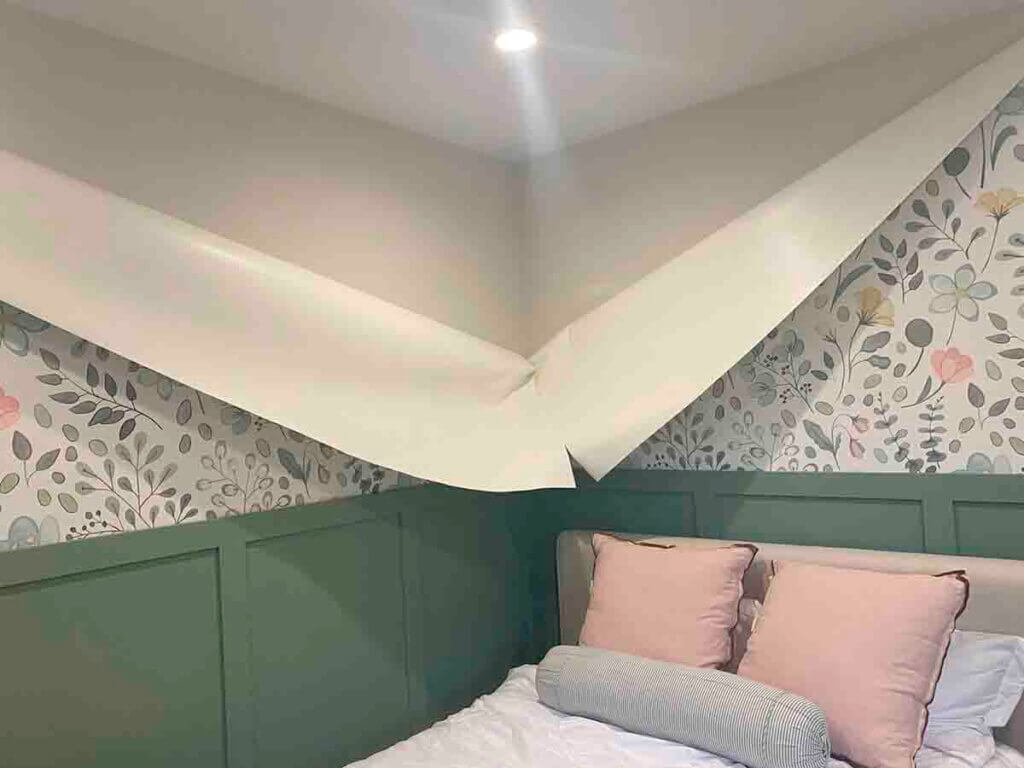
On one project, direct sunlight repeatedly heated the wall.
After the installation had been completed, the peel-and-stick material eventually began losing adhesion and released from the wall in large sections.
The wall had been prepared carefully.
The installation itself had been completed correctly.
The problem developed later.
We do not use this example to claim that every peel-and-stick product will behave the same way.
It is simply one of the real-world experiences that has made us much more cautious about recommending self-adhesive wallcoverings for permanent installations.
Colorado homes can expose wallcoverings to strong sunlight, substantial surface heating, seasonal temperature changes, and very dry interior conditions.
A product may look excellent immediately after installation and still behave differently months later.
One of the most common selling points of peel-and-stick wallpaper is DIY installation.
Some homeowners absolutely can install it successfully.
Our experience, however, includes many projects where the client attempted the installation first and then called us after two or three panels.
That happens because wallpaper installation is not difficult simply because paste is involved.
Removing paste does not remove the geometry of the room.
The installer still needs to:
keep a full-height panel straight;
align the pattern;
maintain consistent seams;
compensate for walls that are not plumb;
deal with ceilings that are not level;
work through corners;
trim cleanly around windows and doors;
handle outlets and switches;
prevent wrinkles and bubbles;
avoid damaging the material while repositioning it.
A panel that starts only slightly out of alignment can be noticeably wrong by the time it reaches the bottom of the wall.
And self-adhesive material can make correction difficult because it may grab the wall before the installer has finished positioning it.
This is why “no paste required” and “easy to install” are not the same statement.
One major advantage of many traditional wallcoverings is the ability to use an installation system appropriate for the material.
Depending on the wallcovering and manufacturer specifications, that system may include a suitable primer and professional wallpaper adhesive.
A professional adhesive can provide working time, controlled slip, strong bonding characteristics, and compatibility with the wallcovering backing and prepared wall.
That gives the installer much greater control over placement and final adhesion.
With peel and stick, the adhesive system is already built into the product.
We cannot simply choose another adhesive because the wall would benefit from different working characteristics.
That difference is important.
It is one reason why we are generally more confident using traditional wallcovering systems for permanent installations.
The phrase “traditional wallpaper” covers a very broad category.
Non-woven wallpaper, vinyl, grasscloth, textile wallcoverings, paper products, designer wallpaper, murals, and commercial wallcoverings all behave differently.
The correct material depends on the room, wall condition, design goal, budget, traffic level, and expected service life.
For clients who have not selected a product yet, Enjoy The Wall can help with wallpaper selection and sourcing before the material is ordered.
We regularly review material construction, pattern scale, texture, backing, installation requirements, expected seam visibility, and suitability for the intended room before a project begins.
That can prevent a beautiful product from being specified for the wrong wall.
Enjoy The Wall works with a growing range of premium and established wallcovering manufacturers.
Our role does not necessarily begin when the boxes arrive at the client’s house. We can review a manufacturer, collection, pattern, construction, and installation requirements before the order is placed.
Clients can explore our current wallpaper brands and dealer relationships to see many of the manufacturers we work with.
Our work includes brands such as Phillip Jeffries, Schumacher, Milton & King, Graham & Brown, York, Thibaut, Farrow & Ball, Sandberg, Brewster, Osborne & Little, and other manufacturers.
Our available dealer and sourcing relationships continue to grow.
If a client already knows the manufacturer, collection, or pattern they want, we can review it before ordering.
If they do not, we can help compare products and determine whether a wallcovering is appropriate for the wall, room, and installation conditions.
This matters because the cheapest material is not always the least expensive project, and the most expensive material is not automatically the right material either.
The objective is to match the wallcovering to the actual project.
| Factor | Peel and Stick | Traditional Wallcovering |
|---|---|---|
| Adhesive system | Factory-applied adhesive | Separate adhesive system based on material requirements |
| Surface tolerance | Often very low | Depends on material; more options are available |
| Textured walls | Usually require substantial preparation | Preparation still required, but material choice is broader |
| Thin wall defects | Frequently visible | Some materials are more forgiving |
| Repositioning | Can be difficult | Often greater working control |
| DIY marketing | Very common | Professional installation commonly expected |
| Installer control | Limited by built-in adhesive | Greater control over preparation and adhesive system |
| Material construction | Often relatively thin | Ranges from lightweight non-woven to substantial vinyl, textile, and natural materials |
| Permanent installations | Possible, but highly surface-dependent | Generally our preferred system |
| Temporary applications | Can be appropriate | Usually unnecessary for short-term use |
Individual products vary, and manufacturer installation requirements should always be followed.
Clients naturally compare material prices.
That makes sense.
But the price of the roll is only one component of a professionally finished wall.
Consider two hypothetical materials.
The first is relatively inexpensive but requires extensive skim coating and sanding before installation.
The second costs significantly more but is constructed on a substantial non-woven backing and can be installed using a professional adhesive system.
The first roll may be cheaper.
The completed wall may not be.
This is why we encourage clients to think about:
material cost;
required wall preparation;
installation labor;
expected service life;
repairability;
replacement risk;
desired finish quality.
The lowest purchase price and the best long-term value are not necessarily the same thing.
For a long-term residential or commercial interior, our preference is generally a suitable traditional wallcovering rather than peel and stick.
That does not mean every traditional wallpaper is perfect.
It does not mean every expensive wallcovering is better than every inexpensive product.
Our preference is based on the installation system.
Traditional materials usually give us more control over:
surface preparation;
primer selection;
adhesive selection;
positioning;
seam management;
material handling;
long-term bonding;
matching the wallcovering construction to the wall.
That control makes the result more predictable.
And predictability matters when the goal is a wall that should continue looking good years after installation.
Peel and stick is not useless.
There are projects where it can be a reasonable choice.
If the wallcovering is intended for a relatively short period, long-term service life may not be the primary concern.
A stable, smooth, compatible wall provides a much better starting point than a textured or damaged surface.
A small area can present fewer challenges than an entire room with long panels, multiple corners, windows, doors, and pattern transitions.
Sometimes the client simply likes a specific peel-and-stick design.
That is fine.
Our job is to explain the installation conditions and limitations before the project begins so that the choice is informed.
Enjoy The Wall does install peel-and-stick wallcoverings.
But we prefer to be transparent before installation.
We can evaluate the wall.
We can prepare the surface.
We can install the product professionally.
We can work to achieve clean alignment, accurate pattern matching, and a visually strong finished result.
What we cannot control is every aspect of the factory-applied adhesive system or every environmental condition the wall may experience in the future.
Long-term performance can depend on:
wall condition;
paint and primer;
surface compatibility;
the adhesive supplied with the product;
direct sunlight;
temperature;
humidity;
material construction;
manufacturer specifications.
Clients who have already purchased self-adhesive wallpaper can review our professional peel-and-stick installation service to better understand what we evaluate before installation begins.
We would rather explain those variables before installation than pretend they do not exist.
Technically, peel and stick is a type of wallcovering.
But it behaves differently from many traditional wallpaper systems.
That is why we do not think the most useful question is whether peel and stick is “real wallpaper.”
The better question is:
Which wallcovering system is appropriate for this wall and this project?
For a temporary decorative application, peel and stick may be completely reasonable.
For a permanent high-end interior, we usually recommend considering non-woven wallpaper, vinyl, grasscloth, textile, or another professionally installed wallcovering before defaulting to a self-adhesive product.
If the material has not yet been selected, our wallpaper sourcing and designer wallcovering service allows the material and installation requirements to be considered together rather than as two separate decisions.
We have seen peel and stick work.
We have also seen homeowners struggle to install it themselves.
We have seen inexpensive material require expensive wall preparation.
We have seen installations that initially looked excellent develop adhesion problems later.
And we have seen traditional wallpaper systems remain far more predictable because the installer has greater control over the wall preparation, adhesive, material, and installation process.
That is why our position is not:
“Peel and stick can never work.”
Our position is:
Peel and stick is often much less forgiving than homeowners expect, and its low material price can hide the real preparation and installation requirements.
For permanent interiors, we generally prefer traditional professionally installed wallcoverings.
It can work, but we consider it a demanding material for many Denver-area walls.
Textured drywall, surface imperfections, strong sunlight, and changes in interior conditions can all make peel-and-stick installation more difficult.
The best results usually begin with a smooth, stable, compatible surface.
If you are unsure whether your wall is suitable, our Denver Metro wallpaper installation team can evaluate the wall condition and selected material before installation.
We generally do not recommend installing peel and stick directly over significant orange-peel texture.
The adhesive performs best when it has consistent contact with the wall.
Texture reduces that contact and can also become visible through thin material.
Depending on the wall and selected product, preparation may include skim coating, sanding, and other corrective work before installation.
Our peel-and-stick installation service explains more about how this material is handled professionally.
Yes. In many cases, wall preparation is critical.
The fact that the material already contains adhesive does not eliminate the need for a proper substrate.
The wall should be stable, clean, smooth, and compatible with the selected product.
Texture, loose paint, dust, patches, wall damage, and irregular surfaces can all affect the result.
In some cases, the required preparation can become more expensive than the peel-and-stick material itself.
Yes, it is possible.
Professional preparation and installation can significantly improve the result, but they cannot change the adhesive formulation supplied with the product.
Long-term adhesion may also be affected by wall conditions, direct sunlight, surface heating, temperature changes, paint, primer, and other environmental factors.
We have encountered projects where carefully installed self-adhesive wallcovering later released from the wall.
That experience is one reason we avoid promising that any peel-and-stick product will perform indefinitely.
Not necessarily. In many real installations, high-quality non-woven wallpaper is easier to control.
Peel and stick eliminates paste, but the adhesive can grab the wall immediately and make repositioning difficult.
A quality non-woven wallcovering installed using an appropriate adhesive can provide better working time and more control during alignment.
Our broader wallpaper FAQ covers additional questions about wallpaper materials and professional installation.
Many peel-and-stick products are thin and closely follow the wall surface.
Small patches, texture, waves, sanding marks, and other irregularities can become visible through the material.
More substantial wallcoverings may be somewhat more forgiving, although every wallpaper still requires appropriate wall preparation.
The material can be cheaper, but the completed wall is not always cheaper.
If the existing surface needs extensive skim coating, sanding, correction, and preparation, the labor required before installation can eliminate much of the original material savings.
The correct comparison is total project cost, not simply the price of one roll.
There is no single reliable lifespan for every peel-and-stick product.
Performance depends on the manufacturer, adhesive, wall preparation, surface compatibility, environmental conditions, sunlight, temperature, and use of the room.
For that reason, we avoid assigning a universal number of years to peel-and-stick wallpaper.
For permanent interiors where long-term predictability matters, our experience generally favors professionally installed traditional wallcoverings.
It may or may not, depending on the wall and paint system.
Removal performance depends on factors such as paint condition, paint age, primer, wall preparation, adhesive strength, and removal technique.
No installer should assume that every removable wallcovering will release perfectly from every painted wall.
Yes.
We install customer-supplied wallcoverings, including peel and stick, provided we can review the project and material first.
We may recommend additional wall preparation depending on the existing surface and selected product.
Clients who already have the material can review our peel-and-stick wallpaper installation service before requesting an estimate.
Yes. We can help compare materials before you order.
We work with homeowners, interior designers, architects, builders, and contractors who need help selecting wallcoverings based on design, wall condition, durability, room use, and installation requirements.
Our designer wallpaper installation and sourcing service explains more about material selection and sourcing.
Yes. Enjoy The Wall is both a professional installer and a sourcing partner for selected wallcovering brands.
We maintain dealer and sourcing relationships with a growing group of premium and established manufacturers.
You can browse our current wallpaper brands or send us a specific manufacturer, collection, or pattern for review.
If a product is not currently shown on our website, we can often check available sourcing options.
For most permanent projects, we usually prefer an appropriate traditional wallcovering over peel and stick.
The exact recommendation depends on the room and design.
Non-woven wallpaper is often an excellent residential option. Vinyl may be appropriate where durability or cleanability matters. Grasscloth offers a natural material appearance. Textile and premium designer wallcoverings can provide depth and texture that thin self-adhesive products cannot reproduce.
There is no single best wallpaper for every project.
The correct material should be selected around the wall, room, expected lifespan, design, and installation conditions.
Yes. Enjoy The Wall works throughout the Denver metro area and on projects across Colorado.
Our primary service area includes Denver, Aurora, Lakewood, Centennial, Castle Rock, Boulder, and many surrounding communities, with additional projects throughout Colorado.
You can review our complete Colorado wallpaper service areas to find your location.
If you want the finished wall to perform as well as it looks, material choice and installation method should be treated as one decision from the beginning.
+1 (720) 825-7157
Proudly working with clients statewide.
If you are deciding between peel and stick and traditional wallpaper, do not make the decision based only on the price of the roll or the words “easy to install” on the product description.
Start with the wall.
Then consider the material.
Then consider the installation system.
Enjoy The Wall works with homeowners, interior designers, architects, builders, and contractors throughout the Denver metro area and Colorado.
We can install material you have already purchased, evaluate wall conditions before installation, help determine the required preparation, or assist with selecting and sourcing wallpaper from the brands we work with.
Sometimes peel and stick is a reasonable choice.
For permanent interiors, however, our installation experience usually leads us toward a properly selected traditional wallcovering and a professional adhesive system.
The important thing is understanding that difference before the first panel goes on the wall.
Explore Wallpaper & Wallcovering Services · All Services
For Interior Designers, Architects & Builders · View Recent Projects

Find wallpaper, decorative plaster, brands, guides, FAQs and blog articles.