
Home » Wallcovering & Wallpaper Installation » Restaurant wallpaper installation Breckenridge CO
Commercial wallcovering projects are often defined by more than the material itself. Scheduling, substrate readiness, access, coordination with other trades, delivery timing, and the opening date can all be just as important as the wallpaper design.
This restaurant project in Breckenridge, Colorado, was a good example.
Enjoy The Wall was brought in shortly before the restaurant’s scheduled opening, with limited flexibility in the construction schedule. The restaurant was expected to open to guests at 4:00 PM, which meant the wallcovering work had to be completed without interfering with final pre-opening operations.
Our team completed the installation before opening, allowing the restaurant to begin normal service as scheduled.
For commercial projects like this, we provide commercial wallcovering installation for restaurants, hospitality spaces, offices, retail environments, and other commercial interiors throughout Colorado.
This was a time-sensitive restaurant wallcovering installation where schedule control was one of the primary project requirements.
| Project Detail | Information |
|---|---|
| Location | Breckenridge, Colorado |
| County | Summit County |
| Project Type | Commercial restaurant interior |
| Wallcovering | Non-woven wallpaper |
| Primary Area | Restaurant bathroom |
| Schedule Requirement | Complete installation before opening |
| Opening Time | 4:00 PM |
| Primary Constraint | No installation downtime after opening |
The restaurant was still in its final pre-opening phase when our team arrived.
For the owner and management team, the question was not simply whether the wallpaper could be installed correctly. It also had to be completed within the available working window.
That changes how a commercial wallcovering project needs to be approached.
A residential wallpaper project can sometimes tolerate an additional day if unexpected wall conditions are discovered.
A restaurant preparing to open does not necessarily have that flexibility.
Once opening day arrives, unfinished work can affect:
staff preparation;
cleaning;
inspections;
furniture placement;
access to restrooms;
other finishing trades;
and ultimately guest operations.
For this Breckenridge project, the restaurant was scheduled to begin serving customers at 4:00 PM.
The wallcovering installation therefore had a fixed endpoint.
This is one reason we encourage restaurant owners, designers, builders, and general contractors to coordinate wallcovering work as part of the construction sequence rather than treating wallpaper as an isolated decorative task at the end of the project.
The wallcovering used on this project was a non-woven wallpaper.
For this specific installation, its construction worked well with the project conditions and schedule.
Non-woven wallcoverings can offer several practical advantages depending on the manufacturer and product.
These may include:
dimensional stability;
predictable handling during installation;
paste-the-wall installation systems;
good print quality;
consistent panel construction;
and a broad selection of commercial and residential designs.
However, we do not treat “non-woven” as a universal recommendation for every restaurant.
The appropriate material depends on where it will be installed.
A decorative restroom wall, dining area, corridor, bar area, high-contact wall, kitchen-adjacent area, or other commercial zone may have very different requirements.
For some projects, non-woven wallpaper is appropriate.
For others, commercial vinyl or Type II wallcovering may make more sense.
Material selection should be based on the actual use of the space, manufacturer specifications, expected traffic, cleaning requirements, substrate, and design intent.
One important distinction from the way this project had previously been described is that non-woven wallpaper does not automatically eliminate the need for wall preparation.
Every wall needs to be evaluated on its own condition.
Before installing wallcovering, we may need to consider:
wall texture;
drywall repairs;
previous paint;
old wallpaper adhesive;
damaged areas;
uneven surfaces;
contamination;
primer compatibility;
surface porosity;
and manufacturer requirements.
On some walls, preparation may be relatively limited.
On others, significant correction may be required before wallpaper should be installed.
That decision comes from inspecting the wall and understanding the material — not simply from seeing the words “non-woven” on the product description.
For projects where additional surface work is needed, we also provide wallpaper removal and wall preparation as part of the installation process.
A restaurant shortly before opening is different from a finished residential interior.
Other trades may still be working.
Furniture, lighting, plumbing fixtures, accessories, signage, cleaning crews, and final construction details may all be moving through the project at the same time.
That means wallcovering installation needs to be coordinated carefully.
Our work has to account for:
safe access to the installation area;
protection of finished surfaces;
availability of walls;
lighting;
ladders and equipment;
other contractors working nearby;
material staging;
adhesives and cleanup;
and the required handoff time.
The goal is not simply to finish our own portion of the project.
The goal is to complete it without creating unnecessary conflicts for the rest of the team.
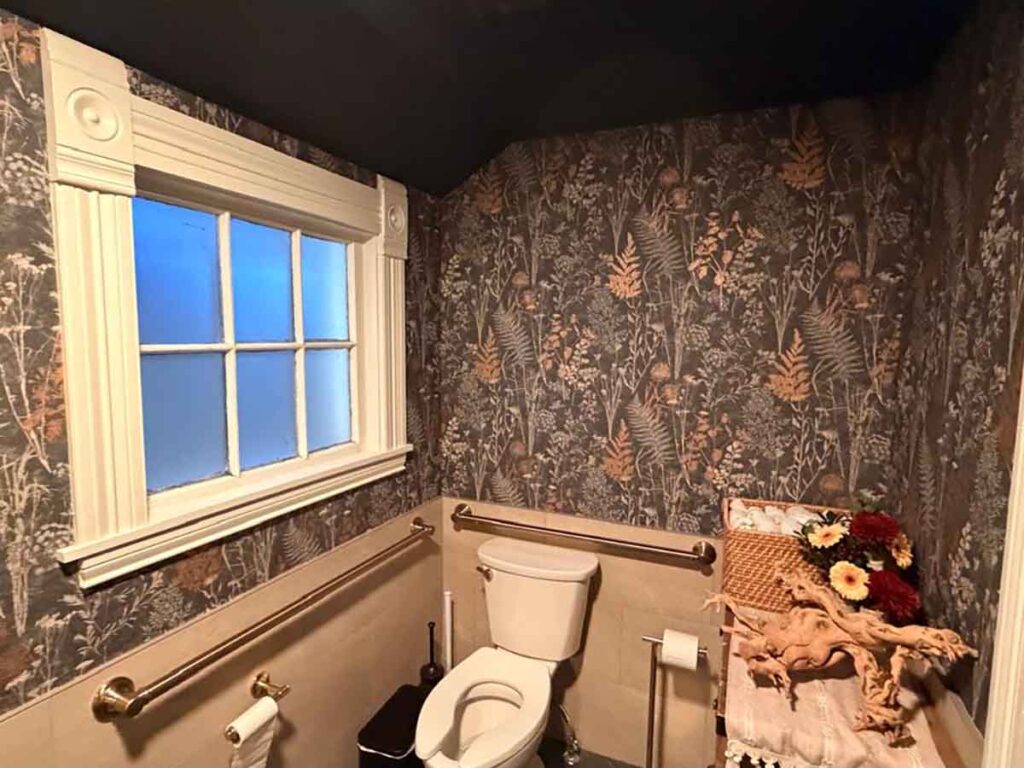
The wallpaper selected for this restaurant bathroom featured a dark botanical pattern.
Dark wallcoverings can produce a strong design result, but they also demand careful installation.
Depending on the product, dark wallpaper can make certain details more noticeable, including:
panel alignment;
edges;
cuts around fixtures;
inside and outside corners;
transitions;
and inconsistencies in seam placement.
Pattern layout is therefore important before the first strip is installed.
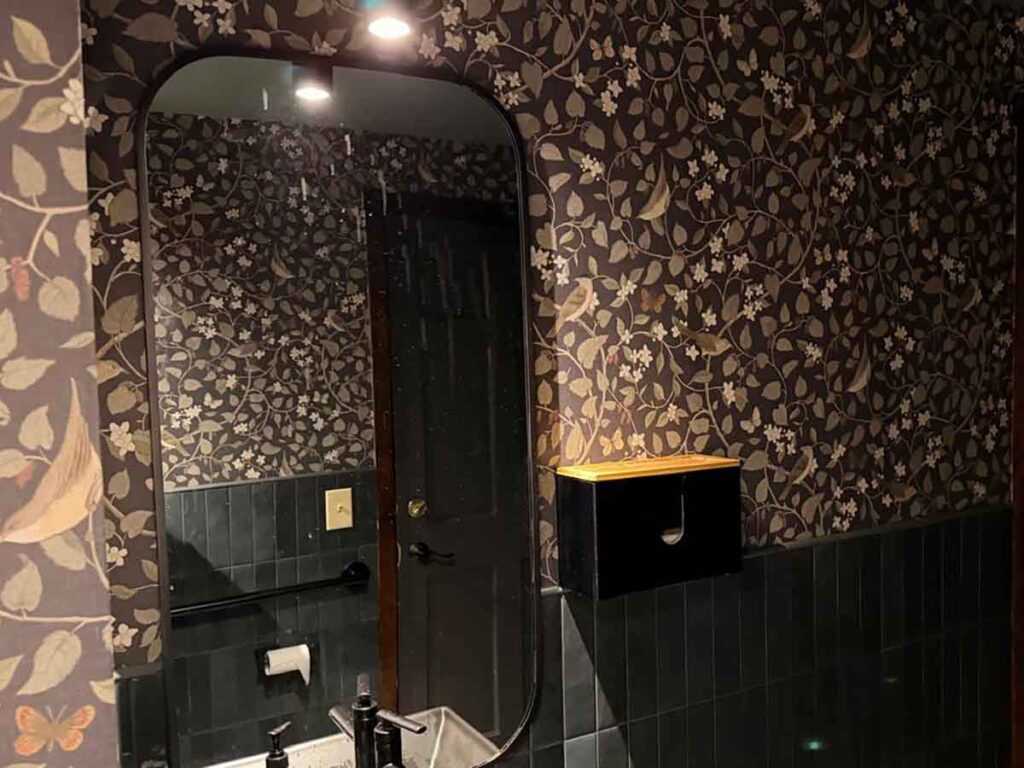
In a compact restaurant restroom, the installer also needs to consider how the design moves around corners, plumbing fixtures, mirrors, doors, ceilings, and other architectural interruptions.
The objective is not simply to match one seam at a time.
The complete room should read as one intentional composition.
Bathrooms and powder rooms are often relatively small, but that does not make them simple wallpaper installations.
In fact, smaller rooms frequently contain more interruptions per square foot than large rooms.
Typical obstacles can include:
doors;
mirrors;
sinks;
toilets;
dispensers;
electrical devices;
plumbing penetrations;
wall-mounted accessories;
corners;
and narrow wall sections.
With a strong botanical pattern, starting-point selection becomes particularly important.
If the layout is poorly planned, the installer may end up with an awkward narrow strip, an important part of the design cut into a corner, or a visually unbalanced pattern around a focal wall.
This is why experienced installers normally study the room before beginning rather than simply starting from the nearest corner.
Despite the limited schedule, our team completed the wallpaper installation before the restaurant opened to guests.
The restaurant was able to begin normal service at 4:00 PM as planned.
For us, the important lesson from this project is not simply that the installation was finished quickly.
Speed by itself is not the objective.
The objective is to create a workflow in which material selection, wall condition, layout, installation, and schedule are understood before they become problems.
That is especially important on commercial projects where delays can affect other contractors or business operations.
In commercial interiors, wallcovering should be considered part of the construction sequence.
The installer may need information from several parties:
owner;
interior designer;
architect;
general contractor;
superintendent;
painter;
drywall contractor;
millwork installer;
electrician;
plumber;
and wallcovering supplier.
For a smooth installation, we want to know whether the wall is actually ready before arriving.
Questions may include:
Is drywall work complete?
Has the wall been painted or primed?
Is the specified primer compatible with the wallpaper?
Are fixtures already installed?
Is millwork complete?
Will other trades need access to the same walls?
Is the wallpaper on site?
Has the quantity been verified?
Are all rolls from the required production lot where relevant?
Has the layout been discussed with the designer?
The earlier these questions are resolved, the lower the risk of discovering a preventable problem during installation.
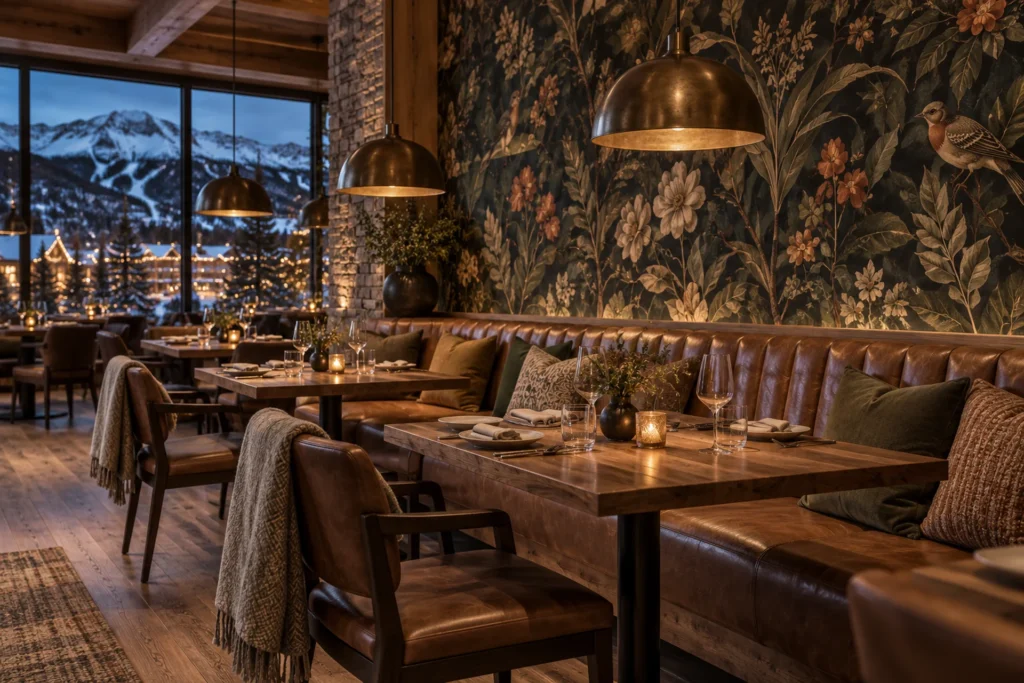
There is no single wallpaper type that is appropriate for every part of a restaurant.
Material selection should follow the actual usage zone.
A decorative restroom may prioritize design and atmosphere.
A high-traffic corridor may require greater resistance to impact and cleaning.
Dining rooms may place greater emphasis on texture, color, acoustics, lighting, and design identity.
Other areas may require commercial-grade performance.
Possible wallcovering categories include:
Suitable for many decorative commercial applications depending on the product and location.
Often considered for high-traffic commercial environments where durability and cleaning requirements are more demanding.
Enjoy The Wall installs Vinyl and Type II wallcoverings for appropriate commercial projects.
Natural wallcoverings can create exceptional visual depth, but their seams, shading, and fiber variation need to be understood before they are specified.
Restaurants often use murals to create brand identity, focal walls, or distinctive guest environments.
Each category has different installation characteristics, so selection should begin with the room requirements rather than simply choosing a product based on appearance.
One of the most expensive wallcovering problems often happens before installation begins: incorrect planning or ordering.
Wallpaper quantity depends on more than square footage.
The installer may need to account for:
roll width;
roll length;
pattern repeat;
pattern match;
wall height;
doors and windows;
waste;
large motifs;
mural panel dimensions;
layout;
and additional material for contingencies.
Ordering too little can stop an installation.
Ordering additional wallpaper later may also create problems if the replacement material comes from a different production lot.
This is why we prefer to be involved before expensive material is ordered whenever practical.
Enjoy The Wall now works not only as an installation company but also as a wallcovering sourcing partner.
We can help homeowners and design professionals review materials, calculate quantities, understand manufacturer specifications, order wallpaper, and coordinate installation.
Clients can explore the wallpaper brands we source and install when selecting material for residential and commercial projects.
This combined approach can be especially useful on restaurant projects because the product decision directly affects:
preparation;
adhesive;
installation method;
schedule;
quantity;
durability;
and finished appearance.
Individual products vary, and manufacturer installation requirements should always be followed.
Breckenridge presents its own logistical considerations for construction and interior finish projects.
Scheduling, site access, material delivery, travel, coordination, and project sequencing can all matter.
However, we avoid making generalized claims that a certain wallpaper type is automatically better simply because a project is located in the mountains.
The correct material should still be selected based primarily on:
the manufacturer’s specifications;
substrate;
interior conditions;
traffic level;
cleaning requirements;
design;
and the intended application.
Enjoy The Wall works on both residential and commercial projects in Summit County. More information about our local installation work is available on our Breckenridge wallpaper installation page.
This restaurant installation illustrates several principles that apply to many commercial wallcovering projects.
The wallcovering affects wall preparation, adhesive, installation method, labor, and scheduling.
A fixed opening time means problems that might be inconvenient on a residential project can become operationally significant on a restaurant project.
Wallcovering should not be used as a shortcut for unfinished or unsuitable walls.
A restroom may have limited wall area but many corners, fixtures, and visual interruptions.
Owners, designers, GCs, and installers benefit when material, quantity, wall readiness, and schedule are reviewed before installation day.
Enjoy The Wall works with homeowners, interior designers, architects, builders, general contractors, and commercial property teams throughout Colorado.
Our recommendations are based on real installation conditions rather than product descriptions alone.
Over years of working with interiors and wall finishes, we have seen how seemingly small decisions involving substrate, material, lighting, quantity, layout, or installation sequence can affect the finished project.
Our team is led by Kris A., Co-Founder, Lead Installer & Design Consultant.
Kris A. combines professional design education with extensive hands-on installation experience and is a member of both the Wallcovering Installers Association (WIA) and the Interior Design Society (IDS).
That combination of design knowledge and field installation experience is particularly useful on commercial projects where appearance, material performance, construction sequencing, and deadlines have to work together.
This Breckenridge project was a real restaurant wallcovering installation completed before a scheduled 4:00 PM opening.
Non-woven wallpaper worked well for this particular project, but it is not automatically the correct wallcovering for every restaurant.
Non-woven wallpaper does not eliminate the need for proper wall evaluation and preparation.
Restaurant wallcovering projects require coordination with the overall construction and opening schedule.
Strong patterns require careful layout, especially in small bathrooms with many fixtures and corners.
Different restaurant areas may require different wallcovering types.
Commercial vinyl and Type II materials may be appropriate where higher durability is required.
Wallpaper quantity should be reviewed before ordering, especially when the project involves large patterns, limited material, or fixed deadlines.
Early coordination between owner, designer, GC, supplier, and installer can reduce unnecessary project risk.
Yes, when the material is selected for the actual location and expected use.
Restaurants contain very different environments. A decorative dining wall, bathroom, corridor, and high-contact service area do not necessarily require the same wallcovering.
Material selection should consider traffic, cleaning, moisture exposure, substrate, design, and manufacturer specifications.
There is no single best material for every restaurant.
Non-woven wallpaper may work well for decorative areas, while commercial vinyl or Type II wallcovering may be more appropriate where greater durability and cleaning resistance are required.
The decision should be made for each installation zone.
Sometimes, but coordination is essential.
If painters, electricians, plumbers, millwork installers, or other contractors still require access to the same walls, the wallpaper can easily be damaged after installation.
The best sequence depends on the specific project.
It can.
Wall preparation depends on the substrate and the wallcovering, not simply on whether the product is non-woven.
Damaged, heavily textured, contaminated, or uneven walls may require preparation before installation.
No.
Type II wallcovering is designed for demanding commercial applications, but not every restaurant wall requires the same performance specification.
The appropriate product depends on the use of the specific wall and applicable project requirements.
Ideally before the wallcovering is ordered and before final wall preparation is completed.
Early involvement gives the installer an opportunity to review quantities, wall condition, manufacturer requirements, layout, and installation scheduling before those decisions become expensive to change.
Yes.
We regularly coordinate wallcovering projects with homeowners, designers, architects, builders, and general contractors.
For trade professionals, our designer and trade support helps connect sourcing, quantity planning, specifications, scheduling, and installation within one workflow.
Planning a restaurant or commercial wallcovering project in Breckenridge or elsewhere in Colorado?
Enjoy The Wall works with restaurant owners, interior designers, architects, builders, general contractors, and commercial clients on projects ranging from individual feature walls and restrooms to specialty wallcoverings and larger commercial installations.
Our team can help evaluate the selected material, wall condition, preparation requirements, quantity, layout, project sequencing, and installation approach before work begins — especially when the project has a fixed construction or opening schedule.
+1 (720) 825-7157
Proudly working with clients statewide.
Restaurant wallpaper installation is not only about hanging material on a finished wall.
A successful project requires coordination between material selection, substrate preparation, quantity, layout, manufacturer requirements, scheduling, and installation.
This Breckenridge restaurant project was completed before the scheduled opening, allowing the business to begin normal guest service at 4:00 PM as planned.
If you are planning a restaurant, hospitality, retail, office, or other commercial wallcovering project in Colorado, Enjoy The Wall can help with material sourcing, project planning, and professional installation.
Explore Wallpaper & Wallcovering Services · All Services
For Interior Designers, Architects & Builders · View Recent Projects

Find wallpaper, decorative plaster, brands, guides, FAQs and blog articles.