Home » Wallcovering & Wallpaper Installation » Spoonflower, NextWall & Serena & Lily Wallpaper Installation Guide
Wallpaper from brands such as Spoonflower, NextWall, Serena & Lily, NuWallpaper, Norwall, Graham & Brown, Chasing Paper, RoomMates, and Wall26 is widely used in homes throughout the Denver metro area and across Colorado.
But one of the most important lessons from our years of installing wallcoverings is simple:
The brand name alone does not tell you how easy — or difficult — a wallpaper will be to install.
The actual installation depends on the specific product construction, backing, adhesive system, wall condition, pattern repeat, print quality, panel width, surface texture, and manufacturer instructions.
At Enjoy The Wall, we work with homeowners, interior designers, architects, builders, and general contractors on both material selection and installation. Our experience comes from working directly with these products on real walls — including materials marketed as DIY-friendly that can become surprisingly demanding once pattern alignment, corners, texture, seams, and imperfect substrates enter the equation.
For projects throughout the Denver metro area, our professional wallpaper installation services include material evaluation, wall preparation, layout planning, quantity review, and installation.
Two wallpapers sold by the same manufacturer can behave very differently.
One collection may be a traditional non-woven wallcovering installed with paste.
Another may be prepasted.
Another may use pressure-sensitive peel-and-stick adhesive.
Another may be printed as individual mural panels.
Even products that appear almost identical online can react differently during installation because of:
backing construction;
material thickness;
surface coating;
ink;
adhesive system;
panel width;
pattern repeat;
edge condition;
stretch;
rigidity;
opacity;
and wall preparation requirements.
This is why we do not approach a project by saying, “We know this brand, therefore every product from that brand installs the same way.”
We inspect the actual material.
Our field experience with specific brands is extremely useful, but the product specification and wall condition still determine the final installation approach.
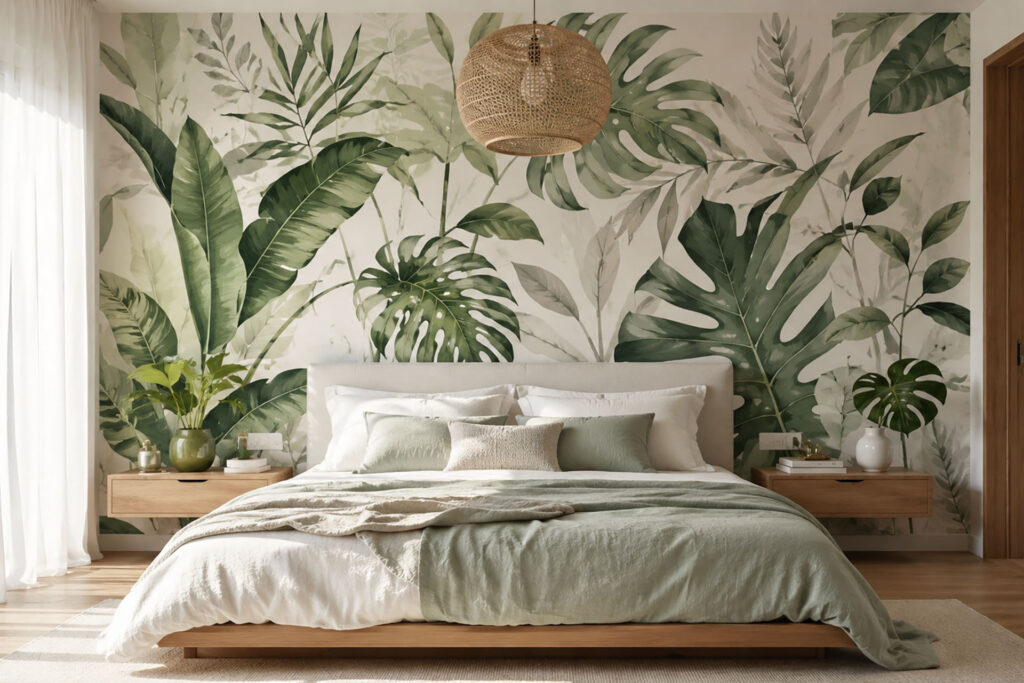
Spoonflower has become extremely popular because of its enormous range of artist-created patterns and custom designs.
We have installed Spoonflower products on many different projects, and our experience has taught us to pay particular attention to the exact material selected.
Depending on the collection and product format, Spoonflower wallpaper may require different handling.
Some of the issues we have encountered or watched carefully during Spoonflower installations include:
material stretching when excessive tension is applied;
visible seam behavior;
sensitivity of the printed surface to excessive wiping;
pattern alignment requiring careful checking;
and occasional print or repeat variations that need to be identified before installation progresses too far.
This does not mean every Spoonflower wallpaper has these characteristics.
It means the installer should inspect the material rather than assuming all digitally printed wallpaper behaves like conventional wallpaper.
With highly visible patterns, botanical designs, geometrics, or large motifs, even a small difference in alignment can become noticeable across several panels.
Before installation, we prefer to review:
panel sequence;
pattern repeat;
print consistency;
wall dimensions;
focal areas;
corners;
doors;
windows;
and the intended starting point.
This becomes especially important when the client has ordered only the calculated minimum amount of material.
Enjoy The Wall works with Spoonflower both as an installation company and as part of our broader sourcing network. More information is available on our Spoonflower wallpaper page.
NextWall, NuWallpaper, RoomMates, Chasing Paper, and many other brands offer peel-and-stick wallpaper.
These products are often marketed toward DIY users because they do not require traditional wallpaper paste.
That does not make them automatically easier to install.
In our experience, peel-and-stick materials can actually be less forgiving than many traditional wallcoverings.
The adhesive begins interacting with the wall immediately.
If the panel is slightly misaligned, repositioning can become difficult depending on the product.
Pulling the sheet back too aggressively can stretch or distort some materials.
Narrow panels can multiply small alignment errors across a wall.
And unlike thicker traditional wallpaper, thin films may reproduce almost every imperfection underneath them.
With NextWall products, one of the things we pay particular attention to is adhesive behavior.
In our experience, some peel-and-stick products can feel very aggressive when initially positioned, while others may feel considerably less secure depending on the substrate.
That means the wall itself becomes critical.
A surface that is:
dusty;
textured;
poorly painted;
contaminated;
overly porous;
or otherwise incompatible with the adhesive
can create problems regardless of how attractive the material is.
Panel alignment also matters.
With narrow strips, a very small deviation near the ceiling can become significantly more obvious after several panels have been installed.
This is why peel-and-stick should still be laid out and installed methodically rather than treated like a large decorative sticker.
We have also seen situations with removable and peel-and-stick wallcoverings where edges become one of the first areas to reveal adhesion problems.
Colorado’s dry indoor environment can make an already marginal installation less forgiving, particularly when other factors are also present, such as:
unsuitable paint;
wall texture;
dust;
high surface temperatures;
strong sunlight;
repeated repositioning;
or inadequate pressure during installation.
The important point is not that every NuWallpaper product will curl.
It is that pressure-sensitive wallpaper depends heavily on the wall surface and installation conditions.
For this reason, wall preparation for peel-and-stick should not be dismissed simply because no paste is being used.
Our dedicated peel-and-stick wallpaper installation service reflects what we have learned working with these materials in real homes.
Norwall offers a wide range of wallcoverings, and individual products can vary substantially.
With some Norwall materials we have handled, trimming and manipulation required more care than with heavier or more dimensionally stable wallcoverings.
A more delicate material can be less tolerant of:
excessive blade pressure;
repeated repositioning;
aggressive smoothing;
overworking around corners;
or unnecessary handling once wet.
This is a good example of why installer experience matters.
The goal is not simply to know how to put wallpaper on a wall.
It is to recognize how this particular wallpaper is behaving while it is being installed and adjust technique before damage occurs.
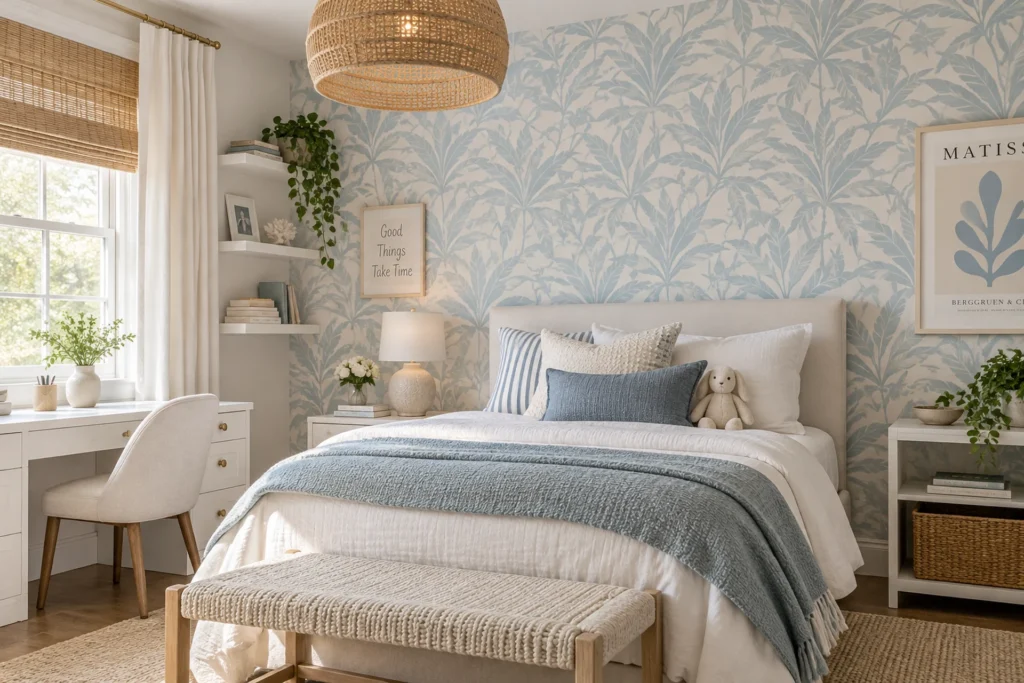
Serena & Lily is frequently selected for refined residential interiors, bedrooms, nurseries, powder rooms, and designer-led projects.
The visual simplicity of many of these designs can be deceptive.
A subtle print often leaves less visual distraction to hide:
wall irregularities;
imperfect seams;
pattern drift;
uneven cuts;
or surface defects underneath the wallpaper.
In our experience, some Serena & Lily wallcoverings are considerably less forgiving of substrate imperfections than homeowners expect.
That makes wall preparation especially important.
A premium wallpaper should not be installed on an unsuitable wall simply because the material itself is expensive.
The final result is always a combination of:
wall + preparation + material + adhesive + layout + installation.
Clients sometimes assume that expensive wallpaper will cover an imperfect wall.
Often, the opposite is true.
A sophisticated wallcovering may reveal defects very clearly because the design is clean, the surface is smooth, or the lighting travels across the wall.
Depending on the product, inadequate preparation can allow the finished installation to reveal:
drywall repairs;
heavy orange-peel texture;
ridges;
poorly sanded patches;
old adhesive;
paint defects;
surface contamination;
or inconsistent wall color beneath lighter materials.
There is no single preparation standard that applies to every wallpaper.
Some walls need minimal correction.
Others require much more extensive work.
The correct approach depends on the substrate, wallcovering, lighting, and manufacturer specifications.
Our wallpaper removal and wall preparation work is therefore an important part of many designer wallpaper installations.
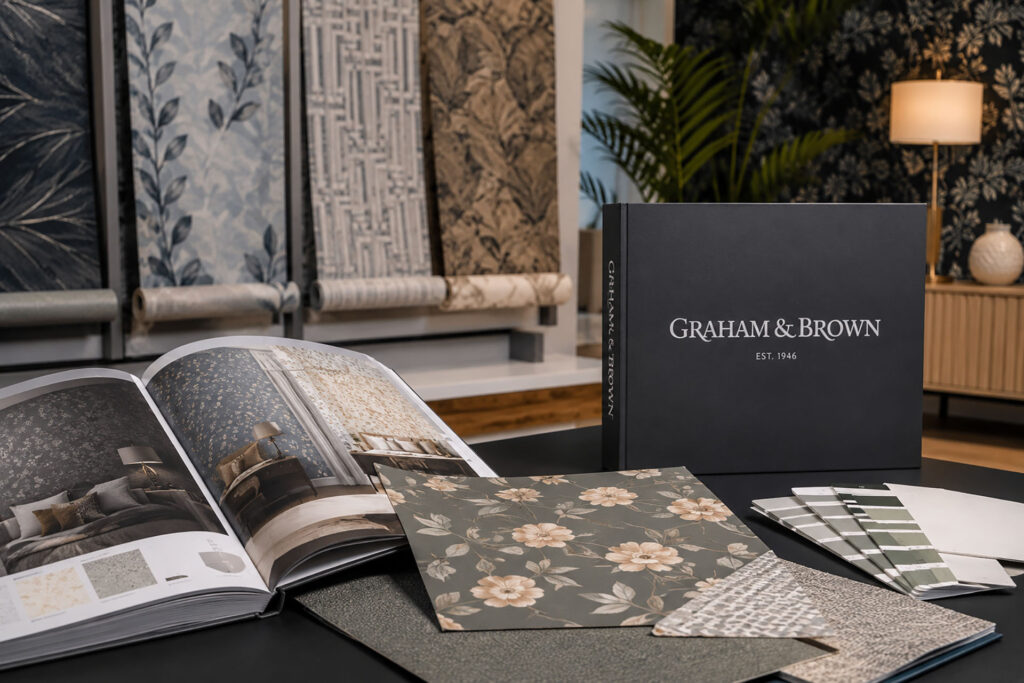
Graham & Brown produces many different types of wallpaper, including textured, printed, and non-woven products.
We have found that some heavier or deeply textured wallcoverings require a different installation approach from thin digitally printed products.
The installer may need to pay particular attention to:
adhesive coverage;
booking or paste-the-wall instructions;
seam pressure;
pattern alignment;
trimming;
and how much the textured face should be manipulated.
Excessive pressure on certain embossed materials can alter the surface or flatten texture around seams.
Too little control can create a different set of problems.
Again, the brand name provides useful background information, but the installer still needs to understand the exact product being installed.
Some wallcoverings sold through Sherwin-Williams or associated collections can be heavier and more rigid than typical lightweight consumer wallpaper.
Stiffer materials often behave differently around:
inside corners;
outside corners;
narrow returns;
trim;
windows;
and architectural details.
Adhesive selection, wall preparation, and working time become particularly important.
The manufacturer’s technical instructions should always remain the starting point for the specific product.
Removable wallpaper can be an excellent solution for:
rentals;
children’s rooms;
temporary design changes;
selected accent walls;
and clients who expect to replace the design later.
However, “removable” does not mean “installation-proof.”
Thin films can be highly sensitive to wall texture.
Small bubbles can become visible.
Repeated repositioning can distort some products.
Pattern alignment can be harder than expected because the adhesive is already active while the installer is trying to move the panel into position.
And if the wall itself is unsuitable for a pressure-sensitive adhesive, professional installation cannot magically change the chemistry of the surface.
Professional experience helps reduce these risks, but the material and substrate still need to be compatible.
Colorado’s climate is dry, and many homes also experience significant seasonal changes in indoor temperature, heating, direct sunlight, and surface temperature.
Over years of installation work, we have seen that these conditions can matter, especially with pressure-sensitive materials.
This does not mean Colorado automatically causes wallpaper failure.
It means there is less room for poor preparation or marginal adhesion when several unfavorable conditions combine.
For example:
a textured wall;
strong afternoon sun;
a thin peel-and-stick material;
repeated panel repositioning;
and insufficient wall preparation
can create a much less predictable installation than the same material on a smooth, properly prepared interior wall.
Traditional pasted wallcoverings and non-woven materials behave differently because they rely on different installation systems.
That distinction is one reason we do not treat peel-and-stick, prepasted, non-woven, vinyl, paper, and natural wallcoverings as interchangeable products.
Large-format murals present a different installation challenge.
With a conventional repeating wallpaper, a small layout adjustment can sometimes be distributed across multiple walls.
A mural usually gives the installer much less freedom.
The image has a fixed composition.
Before installation begins, we need to consider:
total wall dimensions;
panel sequence;
image center;
crop;
ceiling line;
floor line;
windows;
doors;
electrical devices;
furniture;
and any architectural feature crossing the design.
If the first panel is not positioned correctly, every following panel can inherit that error.
This is why large-format installation begins with layout rather than paste.
We provide wall mural and custom print installation for both residential and commercial interiors.
Flower and botanical patterns remain some of the most popular wallpaper choices we install.
They are frequently used in:
bedrooms;
nurseries;
powder rooms;
dining rooms;
home offices;
and accent walls.
Large botanical motifs require careful planning because the eye naturally notices recognizable forms.
A badly placed leaf or flower can be more visually distracting than a small discrepancy in an abstract pattern.
Before hanging these designs, we consider:
dominant motifs;
pattern repeat;
starting position;
symmetry where appropriate;
doors and corners;
furniture placement;
visible focal walls;
and how the pattern continues around the room.
Lighting can also change the way a textured or metallic botanical wallcovering appears, especially when daylight travels across the surface.
No installer can guarantee that every material will behave perfectly on every wall.
But experienced wallcovering installation substantially reduces avoidable risk.
A specialist installer knows to look for problems before they become expensive.
That may include:
poor substrate conditions;
insufficient material;
pattern-repeat errors;
questionable panel sequence;
incompatible adhesive;
defective material;
damaged edges;
difficult corners;
excessive stretch;
or installation conditions that should be corrected first.
This matters particularly now that wallpaper installation is increasingly being offered by painters and general finishing crews.
Painting and wallcovering installation overlap in some areas of wall preparation, but they are not the same trade.
Wallpaper introduces its own technical considerations:
pattern layout;
seam placement;
booking;
paste-the-wall versus paste-the-paper systems;
double cutting;
panel sequencing;
natural material variation;
mural layout;
trimming around details;
and manufacturer-specific requirements.
A professional wallcovering installer is not simply applying a finish to a wall.
The installer is managing the relationship between the substrate, the material, the pattern, the room, and the installation system.
Some of the most challenging materials we install are products specifically marketed as easy DIY wallpaper.
There is a simple reason.
Manufacturers need the product to be accessible to consumers, but marketing language cannot account for every actual wall condition.
A tutorial often demonstrates installation on:
a smooth wall;
a simple rectangular surface;
good lighting;
few obstacles;
and ideal access.
A real room may contain:
orange-peel texture;
crooked corners;
ceilings that are not level;
multiple windows;
narrow returns;
switches and outlets;
plumbing fixtures;
built-ins;
sloped ceilings;
or walls that have been repaired several times.
That changes the installation significantly.
This is why “peel and stick” or “DIY wallpaper” should describe the product category — not the difficulty of every real project.
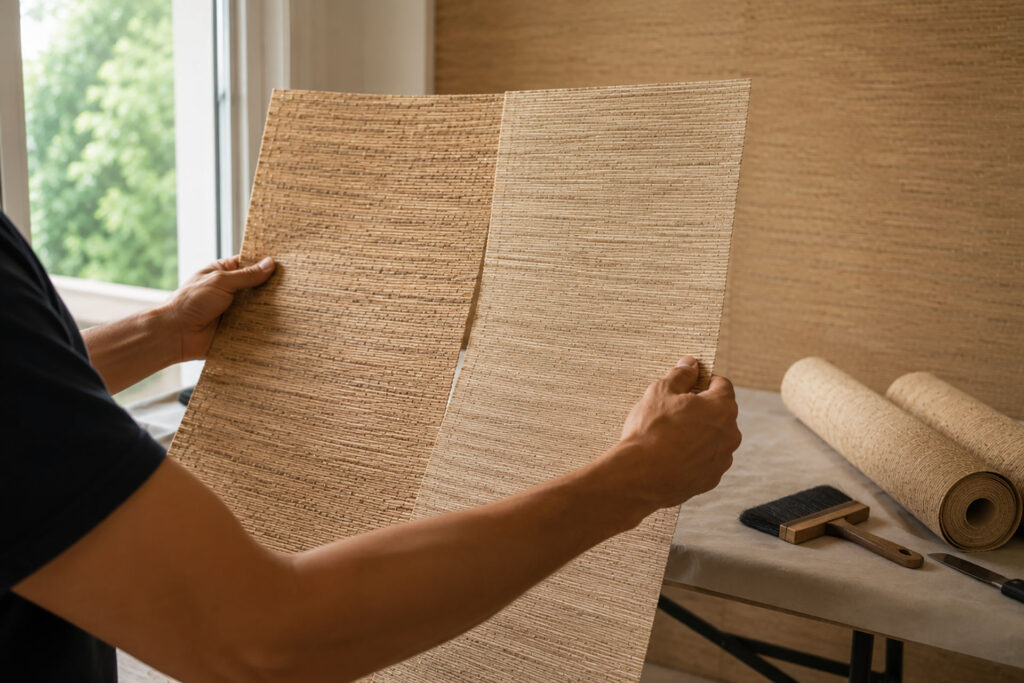
One of the most useful changes at Enjoy The Wall is that we can now work with clients earlier in the process.
We are not limited to arriving after the wallpaper has already been selected, purchased, and delivered.
We can help with:
product selection;
sourcing;
quantity calculations;
pattern repeat;
manufacturer specifications;
material suitability;
wall requirements;
and installation planning.
This can prevent one of the most frustrating problems in wallpaper installation: discovering after delivery that the client has ordered too little material or selected a product poorly suited to the wall.
Enjoy The Wall works with an expanding network of manufacturers and suppliers. Clients and design professionals can explore the wallpaper brands we source and install when planning a project.
At the same time, clients are absolutely welcome to contact us with wallpaper they have already purchased.
Our role is to evaluate the project honestly and determine the best practical installation approach.
We believe wallpaper advice should come from more than product photographs and manufacturer marketing.
Our recommendations are informed by years of working directly with:
peel-and-stick wallpaper;
prepasted products;
non-woven wallcoverings;
paper wallpaper;
vinyl;
commercial Type II;
grasscloth;
natural fibers;
textile wallcoverings;
murals;
metallic materials;
and designer wallcoverings.
That field experience allows us to recognize differences that may not be obvious when two products are viewed online.
A material may be beautiful but unusually delicate.
Another may require more wall preparation.
A third may be extremely stable and predictable.
Another may need additional planning around seams or pattern repeat.
These observations are not intended to label an entire manufacturer’s catalog as “good” or “bad.”
They are part of the practical knowledge developed by installing many different materials under real project conditions.
Enjoy The Wall’s installation team is led by Kris A., Co-Founder, Lead Installer & Design Consultant.
Her background combines design education with extensive hands-on wallcovering installation experience.
Kris A. is a member of both the Wallcovering Installers Association (WIA) and the Interior Design Society (IDS).
That combination is important to the way we approach projects.
Wallpaper installation is partly technical and partly visual.
The installer needs to understand:
the substrate;
the adhesive;
the wallcovering construction;
the pattern;
the architecture;
the room composition;
and the design intent.
For professional design projects, our designer and trade support allows material selection, quantity planning, sourcing, specifications, scheduling, and installation to be coordinated earlier in the project.
The wallpaper brand alone does not determine how difficult the product will be to install.
Different collections from the same manufacturer may use completely different backing and adhesive systems.
Our observations about Spoonflower, NextWall, NuWallpaper, Norwall, Serena & Lily, Graham & Brown, RoomMates, Chasing Paper, and other products come from real installation experience.
Peel-and-stick wallpaper can be less forgiving than many homeowners expect.
Smooth and properly prepared walls are particularly important for thin removable films.
Colorado’s dry indoor conditions, strong sunlight, heating, and temperature changes can make marginal peel-and-stick installations less forgiving.
Designer wallpaper does not automatically hide substrate imperfections.
Large-format murals require careful layout before installation begins.
Professional wallcovering installers reduce the risk of bubbling, stretching, poor seam placement, pattern drift, and other avoidable problems.
Buying, measuring, sourcing, and installation work better when they are considered as one coordinated process.
It depends on the specific Spoonflower material and design.
Some installations are straightforward, while others require additional attention to print alignment, surface handling, pattern repeat, or panel positioning.
We recommend evaluating the actual product rather than assuming every Spoonflower collection behaves the same way.
Yes, but wall condition and installation environment matter significantly.
We have seen successful peel-and-stick installations in Colorado, but smooth walls, clean surfaces, appropriate paint, good adhesion, temperature, and sunlight exposure all matter.
Thin pressure-sensitive wallpaper generally has less ability to disguise surface problems than many traditional wallcoverings.
It can be, but peel-and-stick installation still requires accurate layout and suitable walls.
Adhesive behavior and narrow panel widths can make small alignment errors increasingly visible across a larger wall.
Preparation depends on the actual wallcovering and substrate.
In our experience, some refined Serena & Lily products can make wall imperfections particularly noticeable, so we evaluate the wall before deciding what preparation is appropriate.
Yes.
We regularly work with products purchased directly by clients from online marketplaces, retail stores, manufacturers, and designers.
Before installation, we review the material, quantity, wall condition, and product instructions.
Yes.
Custom murals require careful measurement and layout because their panels normally form one continuous image rather than a repeating pattern.
Sometimes, but not every failed installation can be repaired.
If panels have been stretched, cut incorrectly, damaged, contaminated, or permanently adhered in the wrong position, replacement may be the better option.
We evaluate the existing material before recommending repair or reinstallation.
Yes.
We can help review the material, calculate quantity, evaluate manufacturer specifications, and coordinate sourcing and installation.
For expensive or technically demanding wallcoverings, involving the installer before ordering can prevent costly mistakes.
Wallpaper installation is a specialized trade with technical requirements that differ from painting.
Some painters also have genuine wallcovering experience, but the important question is not the contractor’s job title — it is whether the person installing the wallpaper regularly works with pattern layout, seams, murals, natural materials, specialty wallcoverings, manufacturer specifications, and the specific product being installed.
Already selected your wallpaper or still deciding between materials and brands? Enjoy The Wall can help turn that choice into a properly planned, professionally installed finished wall.
+1 (720) 825-7157
Proudly working with clients statewide.
Planning a designer wallpaper project in the Denver metro area or elsewhere in Colorado?
Enjoy The Wall works with homeowners, interior designers, architects, builders, general contractors, and commercial clients on projects ranging from individual feature walls and powder rooms to custom murals, specialty wallcoverings, and multi-room installations.
Our team can help evaluate the selected material, wall condition, preparation requirements, quantity, pattern layout, sourcing options, and installation approach before work begins.
Explore Wallpaper & Wallcovering Services · All Services
For Interior Designers, Architects & Builders · View Recent Projects

Find wallpaper, decorative plaster, brands, guides, FAQs and blog articles.