
Home » Wallcovering & Wallpaper Installation » Why Wallpaper Seams Show
Wallpaper seams are one of the most misunderstood parts of wallcovering installation.
A visible seam does not automatically mean poor workmanship. Based on our field experience, seam visibility is often determined first by the wallcovering itself, then by the condition and preparation of the substrate, and only then by installation technique.
That order matters.
A skilled installer can control layout, adhesive, trimming, alignment, booking time, seam pressure, and other parts of the installation process. But even a very experienced professional cannot change the physical nature of the material.
Some wallcoverings are designed to blend almost seamlessly. Others naturally show panel transitions, edge contrast, texture changes, shading, or reflective differences.
At Enjoy The Wall, our installation team has worked with enough different wallcoverings, substrates, edge conditions, backing types, coatings, and manufacturer-specific behaviors that very little surprises us anymore. What may look unusual to a homeowner is often a material behavior we have already seen in another form.
For that reason, successful professional wallpaper installation in the Denver metro area starts before the first strip is hung: with understanding the material, evaluating the wall, and setting realistic expectations for the finished surface.
If a client wants nearly invisible seams, the first question should not be, “Who is installing it?”
The first question should be:
What kind of wallcovering is this, and how is it constructed?
In our experience, the wallcovering itself often determines the visual limit of the finished installation.
Important material factors include:
A dark wallpaper printed on a white base can show a fine light edge even when the panels are correctly aligned.
A natural grasscloth can show visible panel transitions because the fibers, tone, and weave vary from strip to strip.
A reflective or coated surface can make a seam more noticeable under grazing light.
A textile or specialty wallcovering may have edge behavior that is completely different from a standard non-woven wallpaper.
This is why we do not judge all wallpapers by one visual standard.

A professional installer can reduce avoidable seam problems, but cannot make every wallcovering behave like a seamless surface.
That distinction is important.
Installer skill matters enormously when it comes to:
But installer skill cannot eliminate inherent material characteristics.
This is especially important with:
A professional installer should know when the material itself will likely show seams — and should explain that before installation whenever possible.
After the material itself, the wall is usually the next major variable.
A wall that looks acceptable under paint is not necessarily ideal for every wallcovering.
Depending on the wallpaper, even subtle surface conditions can become visible after installation.
In Denver-area homes, we regularly encounter:
The thinner, smoother, darker, or more reflective the material is, the more likely the wall condition is to influence the final appearance.
That does not mean every wallpaper project requires the same preparation standard.
Some substantial or textured materials can tolerate minor surface variation better than thin, smooth, or reflective wallcoverings.
The correct preparation depends on the substrate and the specific wallcovering.
For a deeper explanation, see our page on wallpaper removal and wall preparation.
Not always.
Good preparation can remove many avoidable causes of seam problems, but it cannot change the construction of the wallpaper.
Wall preparation can help reduce:
But it cannot eliminate:
This is one of the most important distinctions in wallpaper installation:
Preparation controls the wall. It does not redesign the wallcovering.
Dark wallpaper can be particularly unforgiving when the printed face is dark but the backing or edge is light.
Black, charcoal, navy, deep green, burgundy, and other dark colors can make even a tiny exposed edge more visible.
The effect can become stronger when:
This does not automatically mean the seam is open or poorly installed.
Sometimes the panels are correctly joined, but the physical edge of the material creates contrast.
That is a material-selection issue as much as an installation issue.
Lighting changes the way wallcoverings are perceived.
Grazing light — light traveling almost parallel to the wall — can reveal very small changes in:
This is common near:
The same seam may be barely noticeable from one viewing angle and much more obvious from another.
This does not automatically indicate a defect.
Lighting is part of the visual environment in which the wallcovering must be evaluated.

Natural grasscloth is one of the clearest examples of why wallpaper seams cannot be evaluated by one universal standard.
Grasscloth is made from natural fibers, so neighboring panels can vary in:
Those variations are often part of the visual character of the product.
Visible panel transitions can therefore be normal even when the installation is technically correct.
A client who expects grasscloth to look like a smooth printed non-woven wallpaper may be disappointed even if the installation follows the manufacturer’s requirements.
Our grasscloth and natural fiber installation work requires both technical installation skill and realistic expectation-setting before the project begins.
Wallpaper is not one material category with one installation method.
Textile, metallic, coated, hand-crafted, natural fiber, vinyl, paper, and non-woven products can all behave differently.
Some may be:
That is why experience with standard non-woven wallpaper does not automatically translate into the same result with every specialty wallcovering.
A professional installer must adapt the method to the material.
For higher-end and specialty products, see our designer wallpaper installation service page.
Manufacturer instructions should be treated as the primary technical reference for a specific product.
Depending on the wallcovering, the manufacturer may specify:
Some manufacturers explicitly state that visible seams, shading, or panel variation are normal for certain materials.
That matters.
It is not an excuse for poor workmanship. It is part of the technical standard for evaluating the product.
You can also review the wallpaper brands we work with when researching manufacturer-specific materials and installation requirements.
No.
The fact that some wallcoverings naturally show seams does not mean every visible seam should be accepted.
There is an important difference between:
normal seam visibility
and
an actual installation or substrate problem.
Possible signs of a problem may include:
The correct evaluation depends on the specific wallcovering.
A natural grasscloth seam should not be judged by the same standard as a smooth non-woven wallpaper.
A reflective metallic wallcovering should not necessarily be judged by the same visual standard as a matte printed paper.
The material sets the context.
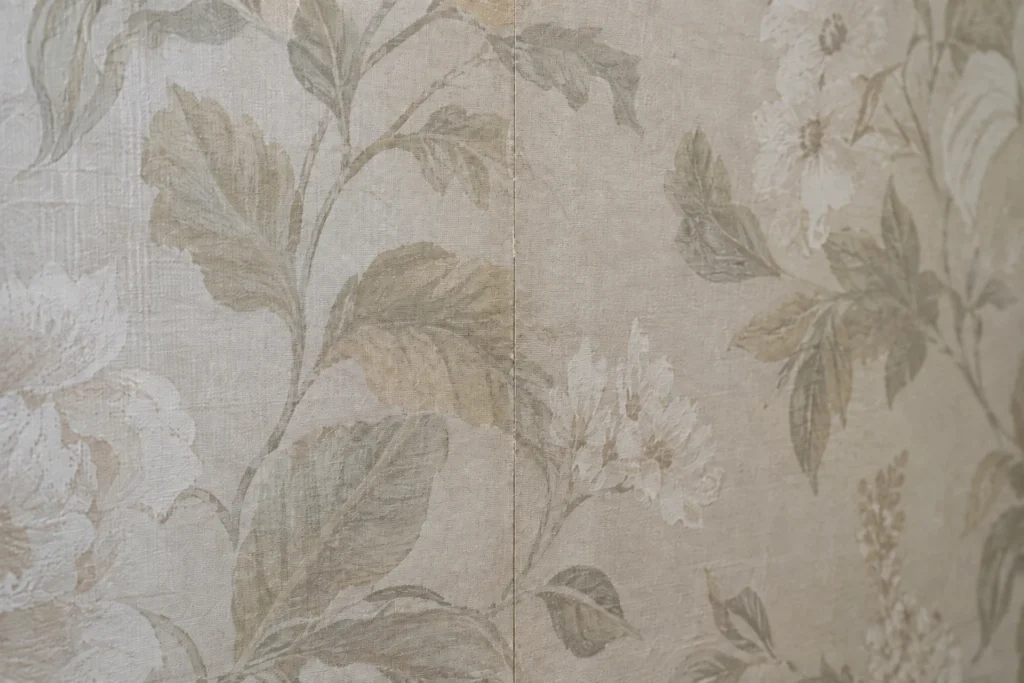
A white or light line between dark panels can have several causes.
It may be:
These causes are not interchangeable.
A properly joined dark wallpaper can still show a narrow light edge if the product is printed on a white base.
An actual open seam is a different condition.
That is why the wall should be evaluated up close before anyone decides whether the issue is material behavior or installation quality.
Some wallcoverings can change dimensions during installation and drying.
Traditional paper products may absorb moisture from adhesive, expand, and then contract as they dry.
Other constructions behave differently.
Non-woven products are generally more dimensionally stable, although the instructions for the specific product still matter.
Potential contributors to seam movement can include:
Again, the material itself must be understood before the seam can be judged fairly.
Sometimes.
The correct repair depends on the cause.
Possible solutions can include:
Not every seam problem can be repaired locally.
Replacement can also create new visual issues if the wallpaper has changed slightly after exposure to light or if the replacement material comes from another production lot.
For that reason, repair decisions should consider the complete wall rather than only one strip.
When we evaluate a seam concern, we do not begin with the assumption that the installer is right or that the installer is wrong.
We look at the system.
That means asking:
This is where field experience matters.
After working with many different wallcoverings and substrates, our team has learned that two seam complaints that look similar in a photograph can have completely different causes.
The correct diagnosis comes from understanding the material, wall, and installation together.
Many seam problems are easier to prevent than repair.
Before purchasing wallpaper, consider:
This is especially important for expensive or specialty wallcoverings.
Enjoy The Wall works with homeowners, interior designers, architects, builders, and general contractors, and we can help evaluate both installation requirements and material suitability before the project reaches the wall.
Not always.
Some wallcoverings can produce very subtle seams, while others naturally show panel transitions because of texture, backing color, reflectivity, or material variation.
The correct expectation depends on the specific product.
In our field experience, the material itself is often the first major factor, followed by wall preparation and then installation technique.
This is not a universal mathematical rule for every project, but it reflects what we repeatedly see across different wallcoverings.
No.
A professional installer can control the installation process, but cannot eliminate inherent characteristics such as natural fiber variation, contrasting backing colors, reflective edges, or manufacturer-defined panel transitions.
The light-colored backing or product edge may contrast with the dark printed face.
A white line can also indicate an open seam or visible substrate, so the actual cause should be evaluated rather than assumed.
Visible panel transitions are common with natural grasscloth.
Natural fibers vary in tone, weave, texture, and reflectivity, and those differences can remain visible after correct installation.
It depends on the product.
Thin, smooth, reflective, or highly uniform wallcoverings usually reveal more substrate variation than thicker or more textured materials.
For more detail, see our article about installing wallpaper on textured walls.
Not completely in every case.
Proper preparation can remove avoidable substrate-related problems, but it cannot change the edge color, texture, reflectivity, or natural variation of the wallcovering itself.
Some wallcoverings can move dimensionally during installation and drying.
The amount depends on the product construction, adhesive system, booking requirements, and installation conditions.
Sometimes.
Lifted edges and certain localized issues can often be corrected, while other problems may require panel replacement or partial reinstallation.
Evaluate the wallcovering before you buy it.
Look at the backing color, surface sheen, material type, natural variation, wall condition, lighting, manufacturer instructions, and the installer’s experience with that class of product.
If you want a finished wallpaper installation that looks intentional up close as well as across the room, seam planning should be treated as part of the overall project — not as a detail to fix afterward.
+1 (720) 825-7157
Proudly working with clients statewide.
If you are planning a wallpaper project and are concerned about seam visibility, wall preparation, or material behavior, the best time to address those questions is before installation begins.
Enjoy The Wall works with homeowners, designers, architects, builders, and general contractors throughout Colorado, combining material knowledge, wall evaluation, preparation planning, and professional installation.
Explore Wallpaper & Wallcovering Services · All Services
For Interior Designers, Architects & Builders · View Recent Projects

Find wallpaper, decorative plaster, brands, guides, FAQs and blog articles.