
Home » Wallcovering & Wallpaper Installation » Wallpaper vs. decorative plaster
Wallpaper and decorative plaster can both transform a wall, but they create very different finished surfaces.
Wallpaper is usually the better choice when the design depends on a specific pattern, illustration, mural, textile effect, or repeatable graphic. Decorative plaster is better suited to clients who want a seamless, handcrafted surface with natural movement, depth, and variation.
Neither option is universally better. The right choice depends on the wall condition, design intent, room, expected maintenance, budget, and how permanent the finish is intended to be.
At Enjoy The Wall, we work with both systems throughout Colorado. Because we install wallcoverings as well as decorative finishes, we evaluate the complete finished wall rather than comparing only the price of the material.
For wallpaper projects, see our professional wallpaper installation in the Denver metro area.
Both materials can create a high-end interior, but they achieve that result in fundamentally different ways.
| Factor | Wallpaper | Decorative Plaster |
|---|---|---|
| Visual character | Printed, patterned, graphic, textile, mural or natural-fiber effects | Seamless, mineral, textured and handcrafted |
| Repetition | Consistent design or pattern repeat | Natural variation; no two applications are exactly identical |
| Seams | Usually present, although visibility varies by material | No wallpaper seams |
| Wall preparation | Depends on material and substrate | Depends on finish and substrate |
| Installation | Panels or strips installed using the appropriate adhesive system | Applied in multiple coats by hand |
| Repairability | Depends heavily on the wallpaper and availability of matching material | Local repairs may be possible, but blending depends on the finish |
| Future design changes | Usually requires removal and replacement | Some finishes can be refreshed, recoated or modified |
| Best suited for | Patterns, murals, grasscloth, printed designs and highly controlled visual compositions | Organic surfaces, seamless feature walls, lime-based finishes and architectural texture |
| Finished appearance | Repeatable and material-driven | Artisan-driven and individually created |
The largest distinction is therefore not simply “smooth versus textured.” Wallpaper is a manufactured wallcovering installed onto the substrate, while decorative plaster becomes part of the finished wall surface itself.
Wallpaper is usually the stronger option when the design depends on imagery or precise pattern.
It can reproduce details that would be extremely difficult or impractical to create manually with plaster: botanical patterns, geometric repeats, panoramic murals, metallic graphics, illustrations, textile effects and large-scale custom prints.
Wallpaper also gives designers significant control over the final composition because the artwork already exists before installation begins.
Different wallcoverings behave very differently, however. Vinyl, non-woven wallpaper, paper, grasscloth and handmade materials cannot be treated as one category.
Pattern placement, seams, backing, wall color, lighting and substrate preparation all influence the finished result.
For designer and specialty wallcoverings, see our designer wallpaper installation services.
the pattern itself is an important part of the design;
a mural or custom image is required;
exact colors or repeated elements must be maintained;
a grasscloth, textile or specialty wallcovering is part of the material palette;
the client wants a finish that can later be removed and replaced with a completely different design.
Wallpaper should therefore not be viewed simply as an alternative to paint. In many interiors, it functions more like a decorative material or architectural surface.
Decorative plaster becomes especially compelling when the goal is a continuous surface rather than a repeated pattern.
Depending on the product and technique, plaster can create subtle cloudy movement, polished Venetian effects, stone-like surfaces, concrete finishes, travertine-inspired texture and other hand-applied architectural finishes.
Because the installer creates the finish directly on the wall, natural variation is part of the material rather than a defect.
Light also interacts differently with these surfaces. Trowel movement, compression, burnishing, texture and sheen can make the same wall appear slightly different as lighting conditions change throughout the day.
Explore our decorative plaster and specialty wall finishes.
a seamless appearance is important;
the design calls for natural movement rather than a repeated pattern;
large wall areas need visual interest without a strong graphic;
the client wants a handcrafted architectural finish;
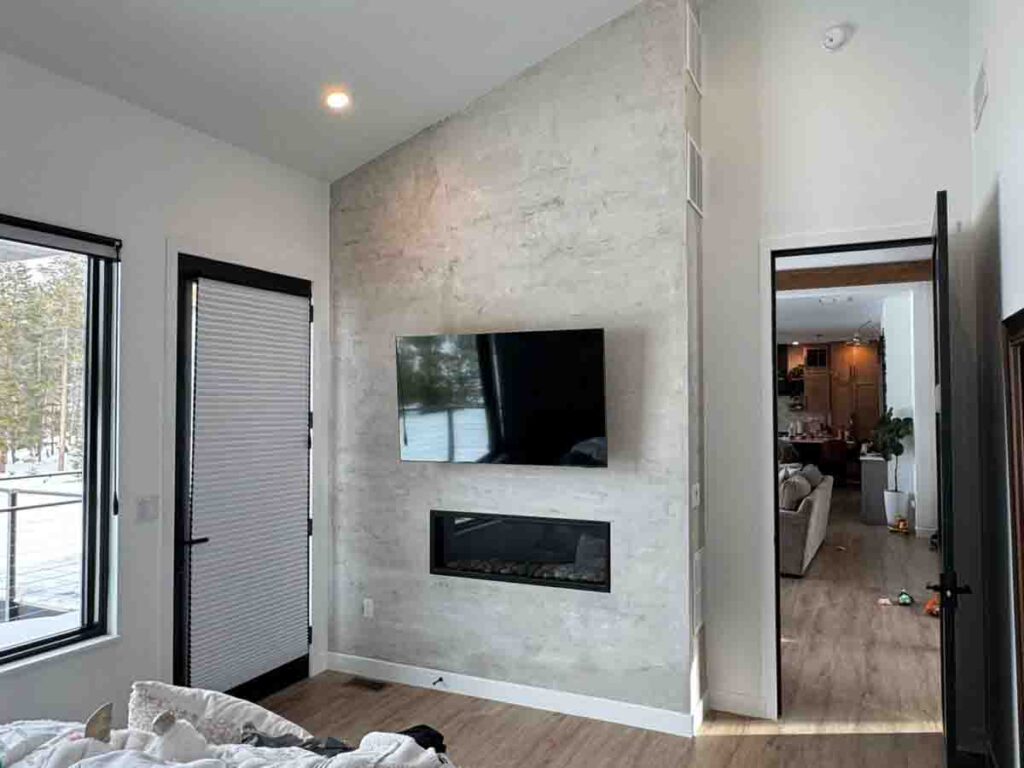
fireplaces, feature walls or large open spaces need a monolithic surface.
For more specific examples, see our pages on Venetian plaster finishes and decorative concrete plaster.
Neither wallpaper nor decorative plaster can compensate indefinitely for a poorly prepared substrate.
The preparation method, however, is different for each system.
Wallpaper may require smoothing, patching, sanding, sealing or priming depending on the wallcovering, wall texture and manufacturer requirements. Thin or reflective materials can reveal imperfections that heavier or more dimensional wallcoverings may disguise.
Decorative plaster also requires a stable substrate. Cracks, loose coatings, contamination, excessive texture or incompatible previous finishes can affect the final surface.
The exact preparation system depends on the plaster product and the condition of the wall.
This is why comparing only the material price can be misleading. The condition of the substrate may materially affect the total installed project cost for either option.
Wallpaper is installed in individual strips or panels, so seams are an inherent part of the system.
Professional installation can make seams very controlled, but whether they become visually noticeable depends on the wallcovering construction, edge condition, color, pattern, lighting and substrate.
Some materials are specifically expected to show panel variation or seams. Natural grasscloth is a common example.
Decorative plaster does not have wallpaper seams because the material is applied continuously across the surface.
That does not mean plaster is visually uniform. In fact, variation from trowel movement, color depth and hand application is often one of the reasons clients choose it.
The design question is therefore different:
Wallpaper manages transitions between manufactured panels. Decorative plaster manages variation within one continuous handcrafted surface.
There is no universal answer because durability depends on the specific material, preparation, location and use of the room.
A quality commercial vinyl wallcovering can be extremely durable. A delicate handmade paper or natural fiber may require much more careful treatment.
Similarly, different decorative plaster systems have different hardness, water resistance, cleanability and maintenance requirements.
High-traffic spaces therefore need to be evaluated according to the actual product rather than broad categories such as “wallpaper” or “plaster.”
Manufacturer specifications remain especially important when moisture, cleaning, abrasion or commercial use is involved.

Wallpaper repair depends heavily on the type of damage and whether matching material remains available.
If a panel is severely damaged, replacement may require material from the same production run. Color variation between batches can sometimes make a later replacement visible.
Small wallpaper issues may occasionally be repairable without replacing a full wall, but the result is material-specific.
Decorative plaster can sometimes be repaired locally, although matching an existing handcrafted texture and color can also require considerable skill.
A patch may need to be blended into a larger surrounding area rather than treated as an isolated spot.
Neither system should therefore be described as universally “easy to repair.”
The answer depends on what kind of freedom you want.
Wallpaper offers enormous freedom in graphic design.
You can choose:
large botanical patterns;
traditional motifs;
abstract graphics;
metallics;
murals;
custom artwork;
natural fibers;
textile wallcoverings;
highly detailed printed surfaces.
Decorative plaster offers enormous freedom in surface design.
Color, texture, trowel movement, sheen, layering and application technique can all influence the final appearance.
For clients selecting wallcoverings, Enjoy The Wall can also help evaluate material construction and installation requirements before ordering. You can explore wallpaper brands we work with rather than treating every manufacturer and product as interchangeable.
Yes. Some of the strongest interiors use both.
There is no need to choose one finish for an entire house.
For example, a designer might use a mural or patterned wallpaper in a powder room, dining room or bedroom while using lime-based or Venetian-style plaster across a fireplace, entry wall or large open living space.
The two finishes can also balance one another visually.
A strongly patterned wallcovering provides graphic structure, while a quieter plaster surface gives the eye somewhere to rest.
The important consideration is coordination between color, sheen, texture and architectural scale.
Either one can be the more expensive option.
Wallpaper project cost may include:
the wallcovering itself;
shipping and ordering considerations;
wall preparation;
primer or liner when required;
installation labor;
additional material required for pattern matching and waste.
Decorative plaster cost may include:
substrate preparation;
specialty primers or base coats;
finish materials;
multiple application stages;
sanding, compression, burnishing, waxing or protective coatings where appropriate;
skilled application labor.
Luxury wallcoverings can cost substantially more than some plaster materials, while elaborate multi-layer plaster systems can exceed the installed cost of many wallpapers.
For that reason, we prefer comparing the complete installed wall, not simply the price of one roll or one container of plaster.

Start with the finished effect you are trying to create.
Choose wallpaper when the room needs a specific graphic, mural, repeat, textile effect or recognizable pattern.
Choose decorative plaster when the goal is a seamless architectural surface with depth, movement and handcrafted variation.
Then evaluate the practical considerations:
condition of the existing walls;
type of room;
maintenance expectations;
exposure to traffic or moisture;
long-term design plans;
project budget;
availability of replacement material;
manufacturer requirements.
In many projects, the best answer is not wallpaper or plaster.
It is deciding where each material contributes the most to the overall interior.
Wallpaper and decorative plaster create fundamentally different types of surfaces.
Wallpaper offers controlled patterns, murals, graphics and manufactured material effects.
Decorative plaster creates a seamless, hand-applied architectural finish.
Neither material is automatically more durable or easier to repair; performance depends on the specific product and installation system.
Wall preparation can significantly affect both appearance and project cost.
Wallpaper seams are part of a panel-based installation system, while decorative plaster replaces seams with natural handcrafted variation.
Both materials can be successfully combined within the same interior.
The best choice should be based on the complete finished wall rather than material price alone.
Not universally. Decorative plaster is better when a seamless, handcrafted surface is the goal, while wallpaper is generally better when the design depends on a specific print, mural, repeat or wallcovering material.
It depends on the products, wall preparation and installation requirements. Premium wallcoverings can be very expensive, while multi-stage decorative plaster finishes can also involve significant material and skilled labor costs.
The useful comparison is the total installed project cost.
There is no single lifespan that applies to either category. Longevity depends on substrate preparation, material quality, room conditions, use, maintenance and the specific product.
Sometimes, but the existing texture usually needs to be evaluated and may require preparation first. The appropriate preparation depends on the texture, substrate and selected plaster system.
Some texture can be addressed, but many wallcoverings perform best on a properly prepared smooth substrate. Thin, glossy or highly detailed materials tend to reveal wall imperfections more readily.
For difficult substrates, see our wallpaper removal and wall preparation services.
No, but completely invisible seams cannot be promised for every material. Seam appearance depends on wallcovering construction, edge condition, pattern, wall color, lighting and installation method.
Yes. A patterned wallpaper can be paired with a quieter plaster finish to create contrast between graphic detail and architectural texture.
Decorative plaster is frequently chosen for fireplace feature walls because it can create a continuous architectural finish, but the correct product must be appropriate for the specific surface and temperature conditions.
The fireplace construction, substrate and manufacturer requirements should be reviewed before selecting the finish.
Not sure whether wallpaper or decorative plaster is right for your space? Our team can help you compare materials, finishes, and installation requirements for your Colorado project.
+1 (720) 825-7157
Proudly working with clients statewide.
Choosing between wallpaper and decorative plaster is easier when the wall condition, material and finished design are evaluated together.
Enjoy The Wall works with homeowners, designers, builders and other trade professionals throughout the Denver metro area and across Colorado. We can help evaluate the existing surface, compare finish options, source appropriate wallcoverings where applicable, plan preparation and complete the installation.
Explore Wallpaper & Wallcovering Services · All Services
For Interior Designers, Architects & Builders · View Recent Projects

Find wallpaper, decorative plaster, brands, guides, FAQs and blog articles.