Home » Wallcovering & Wallpaper Installation » Grasscloth vs vinyl wallpaper denver metro area
Natural grasscloth and vinyl grasscloth wallpaper can look remarkably similar in a small sample, but the finished walls may tell two very different stories. Natural grasscloth offers authentic fibers, irregular weaving, and unique color variations. Vinyl grasscloth reproduces the woven appearance with greater control over color, pattern, and, often, maintenance requirements.
The biggest difference is not simply natural versus synthetic. It is what you should expect your finished walls to look like.
At Enjoy The Wall, we have seen homeowners fall in love with natural grasscloth samples, only to be surprised by the visible color transitions between panels after installation. These variations can be dramatic even when every seam is executed correctly.
That is why material selection matters just as much as workmanship. Through our professional wallpaper installation services in the Denver metro area, we help homeowners, interior designers, architects, and builders understand the characteristics of specialty wallcoverings before purchasing and installing them.
Natural grasscloth is not an inferior material. Quite the opposite: premium natural grasscloth can be an exceptional interior finish. However, its beauty comes from the same natural irregularities that some clients find difficult to accept.
Vinyl grasscloth provides an alternative for those who love the woven appearance but prefer greater consistency, easier maintenance, or improved moisture resistance.
Neither is universally better. The right choice depends on the room, design intent, product specifications, and personal expectations.
Natural grasscloth is made using actual plant fibers or other natural materials, while vinyl grasscloth uses manufactured surfaces designed to reproduce the appearance of woven fibers. Their visual similarity can conceal important differences in seam appearance, moisture sensitivity, installation, and maintenance.
Traditional natural grasscloth may contain sisal, jute, raffia, hemp, arrowroot, or other fibers. Depending on the product, the fibers are woven, assembled, or attached to a backing. Certain high-end products also feature hand-applied color treatments, making every panel even more distinctive.
Vinyl grasscloth uses printed, embossed, or otherwise manufactured surfaces to imitate natural weaving. Some products reproduce the smallest details of natural fibers, while others offer a cleaner, more uniform interpretation.
| Feature | Natural Grasscloth | Vinyl Grasscloth |
|---|---|---|
| Composition | Real natural fibers | Manufactured vinyl surface |
| Appearance | Authentic woven texture | Natural-fiber-inspired texture |
| Color consistency | Irregular, sometimes dramatic variation | Usually more controlled |
| Panel transitions | Often highly visible | Can be considerably more consistent |
| Pattern repeat | No predictable natural color repeat | May have engineered pattern alignment |
| Moisture resistance | Generally sensitive to moisture | Often more moisture-resistant |
| Cleaning | Usually limited, product-specific | Many products are washable |
| Flexibility | Some products are stiff and difficult to bend | Varies; many are more flexible |
| Installation | Requires specialized handling | Depends on construction and specifications |
| Wall imperfections | Texture can conceal minor visual flaws | Depends on thickness and surface texture |
| Replacement | Matching existing panels can be difficult | Often more predictable within the same production run |
| Material cost | Premium and handmade options can be very expensive | Ranges from affordable to luxury |
| Best suited for | Clients who appreciate natural variation | Clients who prioritize consistency and practicality |
These characteristics are general comparisons. Individual products may behave differently, and manufacturer specifications always take priority.
Some premium natural grasscloth products receive hand-applied color treatments or other artisanal finishes.
These techniques create depth, irregular shading, and individual character that cannot be reproduced through a conventional repeating print.
Two adjacent panels may display different concentrations of color, and even sections within the same roll may vary noticeably.
For someone who appreciates authentic natural materials, this irregularity is part of the appeal.
For someone expecting a completely uniform textured surface, it may be disappointing.
A higher material price does not guarantee better color matching. In some luxury collections, more pronounced variation is precisely what makes the product distinctive.
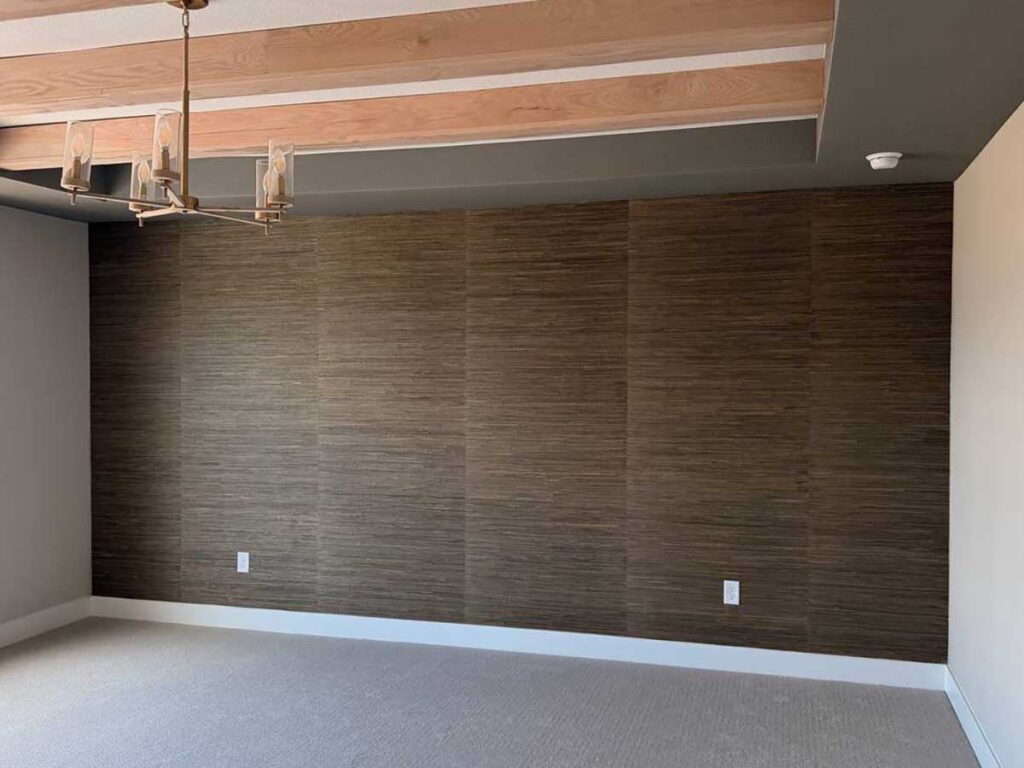
Natural grasscloth often shows pronounced transitions between panels because the fibers, weave, color, and shading are not identical from one strip to another. This is a normal material characteristic, not necessarily an installation defect.
Understanding this distinction is essential before selecting natural grasscloth.
Unlike printed wallpaper, grasscloth is not manufactured to reproduce a perfectly identical image across every strip.
Individual panels may contain different shades, varying fiber thickness, uneven weaving density, and changes in the direction or distribution of the fibers.
When neighboring panels are installed, these variations can create distinct vertical color fields across the wall.
This effect is commonly called paneling or shading.
There is an important difference between the physical seam and the visual transition between two panels.
A professionally installed seam should follow the wallcovering manufacturer’s requirements, with properly handled edges, correct alignment, and the appropriate joint method.
But even when two panels meet perfectly, one may be considerably darker than the other.
The result can be a highly visible vertical transition that has nothing to do with an uneven cut or improper workmanship.
At Enjoy The Wall, we have encountered clients who initially interpreted these natural color differences as installation problems.
In reality, the visible boundary was created by the neighboring materials themselves.
For example, one strip may contain darker brown fibers, while the next has a lighter beige or gray undertone. Their edges may meet correctly, but the panels still appear noticeably different from across the room.
A perfectly executed seam cannot make naturally different fibers and colors identical.
This is particularly important with expensive designer grasscloth, where pronounced material variation may be an intentional part of the finished appearance.
For a broader explanation of seam appearance, see our article on why wallpaper seams become visible.
Cutting additional material does not guarantee matching colors because natural grasscloth typically has no repeating color sequence. It can also produce significant waste, particularly with expensive materials.
This is a situation we have encountered in real installations.
When clients notice that neighboring panels have different shades, they sometimes suggest unrolling more material until a matching section appears.
The idea is understandable. With printed wallpaper, installers can often locate the next matching pattern at a specified repeat.
Natural grasscloth behaves differently.
There is no guaranteed color sequence repeating every 20, 50, or 100 inches.
A section farther into the roll may be lighter, darker, or simply different. There is no assurance that it will match the neighboring panel.
Trying to select only similar-looking sections can create substantial offcuts, require additional rolls, and increase the project’s material and labor costs.
With high-end natural grasscloth, this can become extremely expensive without achieving the desired visual uniformity.
Professional planning can help evaluate panels, consider layout options, and follow manufacturer recommendations. However, it cannot eliminate the inherent variation of natural fibers.
The most effective way to avoid disappointment is to understand the material before placing the order.
Selecting natural grasscloth should be an informed design decision, not a surprise discovered after installation.
At Enjoy The Wall, we explain natural grasscloth characteristics before the client commits to the material.
We show photographs of real installations, including high-end interiors where neighboring panels display clearly different colors, weaving patterns, and fiber textures.
These images demonstrate what a small sample often cannot: how natural variations appear across an entire finished wall.
We also provide written explanations of the material’s characteristics and expected visual differences.
On projects involving interior designers, we coordinate with the designer to help clients understand the selected wallcovering, its intended appearance, and any limitations.
Despite these explanations, we have experienced situations where clients were still surprised by the strength of the color differences after installation.
A small sample may show an attractive woven texture. It may not adequately communicate how several naturally different strips will look side by side.
This is why we believe real installation photographs are often more informative than product samples alone.
Our objective is not to discourage clients from choosing natural grasscloth. We appreciate the material and its unique character.
Our responsibility is to ensure that clients understand what they are purchasing, how it will look, and which results professional installation can realistically achieve.
For designer-led projects, our designer and high-end wallpaper installation services support material review, installation planning, and coordination with other project professionals.

Vinyl grasscloth can reproduce the appearance of natural woven fibers while providing greater control over color distribution, surface texture, and panel alignment.
This makes it particularly attractive to clients who want the grasscloth aesthetic without pronounced differences between neighboring strips.
Modern vinyl manufacturing can reproduce subtle fiber patterns, woven textures, and natural-looking shading.
Some high-quality products are visually convincing, especially when viewed at a normal distance in a completed room.
Certain vinyl grasscloth collections offer highly consistent color and pattern alignment, allowing adjacent panels to blend much more evenly than natural grasscloth.
However, invisible seams are not guaranteed.
The result depends on the particular product, its edge construction, pattern design, wall preparation, lighting, and installation method.
Some manufacturers intentionally reproduce the irregular shading and mismatched appearance of natural woven materials.
In those collections, visible panel transitions may be part of the printed design rather than an installation issue.
Therefore, not every vinyl grasscloth creates a completely uniform wall.
The selected product must be evaluated on its own characteristics.
Many vinyl grasscloth products provide practical advantages over untreated natural fibers.
Depending on their construction and performance rating, they may offer improved moisture resistance, better stain resistance, and easier cleaning.
These characteristics can be valuable in households with children or pets, particularly in areas exposed to frequent contact.
However, not all vinyl products are equally washable, durable, or suitable for commercial use.
Decorative vinyl grasscloth should not automatically be confused with Type II commercial wallcovering. Type II products have specific performance classifications that must be verified.
Learn more about our Vinyl & Type II Wallcovering Installation services.
Natural grasscloth is generally not recommended for moisture-prone environments unless the manufacturer specifically approves the intended application. Vinyl grasscloth often provides a more practical alternative, depending on its specifications.
Natural fibers are sensitive to changing moisture conditions, splashes, and condensation.
Depending on the product, exposure can cause staining, discoloration, distortion, or other damage.
A powder room without a shower may experience less humidity than a full bathroom, but that does not automatically make natural grasscloth suitable.
At Enjoy The Wall, we consider natural grasscloth in powder rooms only when the manufacturer permits the application.
We also evaluate ventilation, potential water exposure near the sink, and the expected cleaning requirements.
If the product is not approved for those conditions, we recommend exploring a more appropriate alternative.
Many vinyl wallcoverings provide greater resistance to moisture and routine cleaning than natural grasscloth.
This can make them a practical choice for certain bathrooms, laundry rooms, and utility spaces.
However, moisture-resistant does not necessarily mean waterproof.
The wallcovering must be suitable for the intended environment, and the underlying wall must be dry, sound, and properly prepared.
Vinyl wallcovering is not a replacement for waterproofing, ventilation, or proper moisture management.
Our article on bathroom wallpaper and moisture-resistant solutions explores additional material considerations.
Seasonally occupied homes, mountain cabins, and unheated rooms may experience significant changes in temperature and humidity.
These fluctuations can affect installation conditions and long-term material performance.
Both natural and vinyl wallcoverings should be evaluated for compatibility with the environment.
Installation should take place under the temperature and humidity conditions required by the manufacturer, and the property should maintain suitable conditions afterward.
Natural grasscloth is often easier to plan for a simple accent wall than for an entire room with multiple corners, architectural transitions, and complex details.
A single feature wall may have relatively straightforward panel placement, with fewer changes in direction and fewer complicated cuts.
Natural grasscloth can create a striking feature behind a bed, in a dining room, or on a living room wall.
However, visible color transitions between adjacent strips will still be part of the appearance.
An accent wall does not eliminate natural paneling.
Installing grasscloth throughout an entire room introduces additional considerations.
Inside and outside corners, windows, doors, narrow returns, built-in cabinetry, sloped ceilings, and transitions between surfaces can complicate the installation.
Many natural grasscloth products contain relatively stiff fibers that resist sharp bending.
Wrapping a continuous piece around an outside corner, for example, can be difficult and may not be appropriate for the specific material.
Some configurations can be completed with careful handling and additional labor. Others require separate panels or a different seam layout.
More complicated geometry can also increase material consumption and installation costs.
Vinyl grasscloth may offer greater flexibility in certain applications, but this depends on the backing, thickness, and construction.
Neither material should be assumed suitable for every architectural condition.
For more technical details, read our guide to the challenges of installing grasscloth wallpaper.
Professional grasscloth installation requires more than accurate cutting and careful handling.
It requires understanding how the selected wallcovering interacts with the substrate, adhesive, primer, environmental conditions, and seam system.
At Enjoy The Wall, we follow the installation instructions provided by the manufacturer of each specific wallcovering.
That includes adhesive selection, wall preparation, material handling, panel orientation, and seam treatment.
Our experience helps us assess existing walls, identify possible adhesion problems, determine the necessary preparation, and plan the installation before work begins.
The correct seam method is determined by the construction and installation requirements of the wallcovering.
Some grasscloth products have factory-finished edges intended to be installed with butt joints.
Other products require overlapping adjacent panels and creating the final seam using an overlap double-cutting method.
We use the technique specified by the manufacturer.
An accurate double-cut requires careful control and appropriate protection of the underlying surface.
However, regardless of the technique, a properly executed physical joint cannot eliminate the natural shading difference between two grasscloth panels.
This is why professional workmanship and visual material consistency must be evaluated separately.
Different wallcoverings require different levels of substrate preparation.
Our team evaluates existing paint, wall texture, surface integrity, moisture conditions, and other factors before determining the appropriate preparation.
Depending on the wallcovering, the process may involve smoothing surface irregularities, repairing damaged areas, applying a compatible primer, or addressing existing adhesion problems.
The correct combination of substrate preparation, primer, adhesive, and installation procedure is essential for long-term performance.
See our wallpaper removal and wall preparation services for more information.

The pronounced texture of certain grasscloth products can visually conceal minor cosmetic wall imperfections, but it does not eliminate the need for proper preparation.
This is one of the practical advantages of some heavily textured natural wallcoverings.
Their irregular fibers and dimensional surfaces can make small visual defects less noticeable than they would be beneath a thin, smooth wallpaper.
However, the result depends on lighting, wall condition, material backing, and the severity of the imperfections.
Grasscloth should not be used to conceal unstable paint, moisture damage, significant unevenness, or other conditions that can compromise installation.
In particular, the presence of existing wall texture does not automatically mean a wallcovering can be installed directly over it.
This applies to vinyl products as well.
Our article about the problems of installing vinyl wallpaper on textured walls explains why surface preparation remains important even with manufactured wallcoverings.
Natural grasscloth can be considerably more expensive than many vinyl alternatives, but the total installed cost depends on more than the price of the material.
Premium natural grasscloth may involve specialized fibers, labor-intensive weaving, hand-applied finishes, or limited-production collections.
Some products are exceptionally expensive.
Vinyl grasscloth is available across a broad range of prices, including premium designer collections.
The cost comparison should account for the complete installation rather than the price per roll alone.
Important factors include material width and usable coverage, wall preparation, adhesive requirements, installation labor, room geometry, and potential waste.
Natural grasscloth can become especially expensive when clients request selective cutting to minimize visible color differences.
Because natural variations do not follow a predictable repeat, additional material consumption may not produce a more consistent appearance.
Complex architectural details may also require more time and careful handling.
A less expensive material does not always mean a less expensive completed project, and a higher material price does not guarantee the visual consistency a client expects.
The right choice begins with an honest understanding of the desired appearance.
Natural grasscloth is an excellent choice for clients who value real woven fibers, organic texture, and the distinctive appearance of natural materials.
Its individuality is an advantage when the design celebrates variation rather than perfect repetition.
It can be particularly beautiful in living rooms, bedrooms, dining rooms, private offices, and other appropriate spaces where moisture exposure is controlled.
For clients who understand and appreciate the material, natural grasscloth offers an appearance that manufactured alternatives cannot completely reproduce.
Explore our Grasscloth & Natural Fiber Installation services.
Vinyl grasscloth may be the better choice when a client wants the appearance of natural woven fibers but prefers more predictable color alignment, easier maintenance, or improved moisture resistance.
It is also worth considering in busy households, selected commercial spaces, and rooms where the manufacturer approves a suitable vinyl product but not a natural fiber alternative.
The goal is not to choose vinyl because natural grasscloth is defective or outdated.
It is to choose the material that delivers the intended result.
We appreciate natural grasscloth. We understand why designers specify it, why homeowners are attracted to it, and why premium natural materials remain desirable.
We also understand why some clients are happier with vinyl grasscloth.
Our recommendation depends on the individual client and the specific room.
When a client understands that visible paneling, irregular fibers, and color differences are part of natural grasscloth, those characteristics can be celebrated.
When a client expects a consistent textured surface with closely matched panels, vinyl may offer a better solution.
Neither decision should be based on appearance in a small sample alone.
Natural grasscloth is a material to appreciate, not a printed pattern to match.

Natural grasscloth is a premium wallcovering valued for authentic fibers and distinctive natural variations.
Visible paneling and shading are common characteristics of natural grasscloth, not automatically evidence of defective installation.
Even a technically perfect seam cannot eliminate color differences between naturally woven panels.
Cutting additional material to find matching shades can create significant waste without guaranteeing a match.
Vinyl grasscloth can provide a similar woven appearance with greater consistency and, depending on the product, improved durability and cleanability.
Natural grasscloth should only be used in powder rooms or other potentially humid spaces when the manufacturer permits that application.
Complex room geometry, corners, and returns can make natural grasscloth installation more difficult.
Proper wall preparation, adhesive selection, and seam techniques must follow manufacturer instructions.
The best choice depends on the client’s expectations, the room, and the specific material.
Yes. Visible transitions between natural grasscloth panels are common because neighboring strips can differ in color, fiber texture, weaving pattern, and shading.
A properly installed seam can remain visually noticeable. Natural paneling should not be confused with defects such as damaged edges, improper cutting, or unintended gaps.
Natural grasscloth should not be purchased with the expectation of completely invisible panel transitions.
Even when the physical seam is correctly installed, differences between natural fibers may remain prominent, especially in products with pronounced shading or hand-applied finishes.
Premium grasscloth may feature natural fiber variations, hand coloring, and specialized weaving that intentionally create irregular shading.
A high price does not guarantee uniformity. In many luxury products, variation is an important part of the material’s character.
Natural fiber variation does not normally follow a predictable printed pattern repeat.
Although some grasscloth products incorporate additional printed designs, natural weave and color differences cannot generally be matched by locating another section of the roll.
Installers may evaluate available panels and follow manufacturer layout recommendations, but exact color matching cannot be guaranteed.
Searching for similar shades may create substantial material waste and additional costs without producing a uniform appearance.
Neither is universally better. Natural grasscloth provides authentic fibers and organic variation, while vinyl grasscloth often offers greater visual consistency and easier maintenance.
The appropriate material depends on the room, design goals, and the client’s expectations.
Some vinyl grasscloth products allow very consistent panel alignment, but invisible seams are not guaranteed.
Seam visibility depends on construction, printed design, wall preparation, lighting, and installation. Some vinyl products intentionally imitate the irregular shading of natural grasscloth.
Natural grasscloth should only be considered when the manufacturer approves the intended application and the environment is suitable.
Natural fibers are generally sensitive to moisture. Bathrooms with showers and poorly ventilated areas present additional risks.
Not all vinyl grasscloth products are waterproof, although many provide greater moisture resistance than natural grasscloth.
The manufacturer’s specifications must confirm suitability for the intended room. Moisture-resistant wallcovering does not replace proper waterproofing or ventilation.
Yes. Natural grasscloth can work beautifully on accent walls, especially when the room conditions and surface preparation are suitable.
A simple feature wall may require fewer complex cuts and transitions than a full-room installation, but natural differences between adjacent panels will still be visible.
Some textured grasscloth products can visually conceal minor imperfections, but the wall must still meet the manufacturer’s preparation requirements.
Existing texture, damaged paint, unsuitable coatings, and adhesion problems may require correction before installation.
No. The seam method depends on the specific wallcovering and its manufacturer’s instructions.
Some products require butt joints using factory edges. Others specify overlapping and double-cutting. Professional installers must use the appropriate method for the selected material.
Have questions about natural or vinyl grasscloth wallpaper? Contact Enjoy The Wall to discuss your project, material options, and installation requirements.
+1 (720) 825-7157
Proudly working with clients statewide.
Choosing between natural and vinyl grasscloth involves more than comparing textures or colors. The right decision requires understanding the finished appearance, installation requirements, room conditions, and long-term expectations.
Enjoy The Wall works with homeowners, interior designers, architects, builders, and general contractors throughout the Denver metro area and across Colorado.
Our team can help evaluate wall conditions, review material specifications, coordinate sourcing and installation planning, and explain the characteristics of natural and manufactured wallcoverings before work begins.
Whether your project involves an authentic natural grasscloth feature wall or a more consistent vinyl grasscloth finish, we can help you plan the installation around the material and your expectations.
Explore Wallpaper & Wallcovering Services · All Services
For Interior Designers, Architects & Builders · View Recent Projects

Find wallpaper, decorative plaster, brands, guides, FAQs and blog articles.