Home » Wallcovering & Wallpaper Installation » Uwalls wallpaper installation denver metro area
Custom wall murals can completely change a room, but the finished result depends on much more than the image itself. Wall condition, accurate measurements, surface preparation, panel layout, and installation technique all affect how a mural will look once it is on the wall.
Our Enjoy The Wall installation team recently completed a Uwalls custom mural project in the Denver metro area using a thin non-woven wallcovering with a soft children’s design featuring rabbits, balloons, and clouds.
The material performed well, and our experience with it was positive. But the project also demonstrated something Kris A. and our installers see repeatedly in the field: the thinner and more visually precise the wallcovering, the more important the wall underneath it becomes.
For homeowners, designers, and builders planning similar projects, our professional wallpaper installation in the Denver metro area starts with the same question we considered here: is the wall actually ready for the material being installed?
This article is based on what our team encountered during the Uwalls project and what we would want a client to know before ordering a custom mural.
Uwalls specializes in custom-size murals rather than only conventional repeating wallpaper patterns. The image is produced for the dimensions of a specific wall and divided into panels that form one continuous composition.
That distinction changes the installation process.
With regular repeating wallpaper, the installer is primarily managing pattern repeat, roll sequence, wall geometry, cuts, and overall layout. With a mural, every panel belongs to a particular position within one larger image.
For our project, that meant three things were especially important:
the wall had to be properly prepared;
the mural dimensions had to correspond to the actual finished wall;
every panel had to be positioned accurately so the illustration continued correctly across the seams.
The mural itself was a thin non-woven material. Uwalls currently offers multiple material options, so our observations in this article refer specifically to the type we installed and should not be interpreted as a statement that every Uwalls product behaves identically.
For projects based around one large printed composition, we approach custom wall mural installation differently from a standard repeating wallpaper installation.

There was also a detail on the material that was personally meaningful to our team.
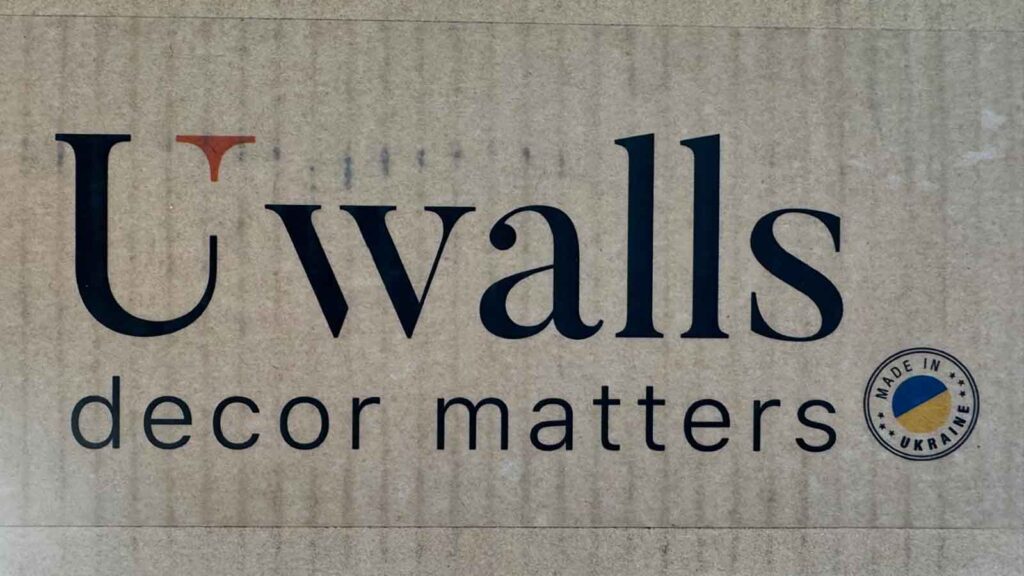
The Uwalls material used for this Denver metro project carried a “Made in Ukraine” label.
Uwalls’ website is currently operated by KLW Sp. z o.o., a company registered in Poland, but we do not want to generalize the manufacturing origin of every product they sell. What we can document directly is the material that was in our hands and installed by our team: this particular Uwalls mural was labeled Made in Ukraine.
For us, that is worth mentioning as part of the history of this specific project rather than making a broader claim about the entire brand.
The most important technical lesson from this project was the wall preparation.
The non-woven mural we installed was relatively thin. It did not give us a heavy surface layer that could visually soften significant imperfections underneath.
The existing wall therefore required full smoothing and preparation before the mural was installed.
One of the most common misconceptions we hear is that wallpaper can simply cover a bad wall.
Sometimes a heavier or more textured material can visually reduce certain minor surface imperfections. But thin wallcoverings can do the opposite: they may follow the substrate closely enough that defects remain noticeable after installation.
Small ridges, patches, uneven texture, poor previous repairs, or other surface irregularities may become easier to see once a clean printed surface is installed over them.
Lighting matters too.
A wall that appears acceptable when viewed straight on can look very different when strong daylight or artificial light travels across it from the side.
This is why our installers do not decide on preparation based only on the word “wallpaper.” We look at the actual wall and the actual material.
This is especially relevant in Colorado.
Our team frequently works in Denver metro homes with textured drywall. The texture can range from relatively light to pronounced, and not every wall requires exactly the same preparation.
The wallcovering matters just as much as the wall.
A heavier or more forgiving material may behave differently over a minor surface condition than a thin, smooth mural. A delicate print, glossy surface, thin non-woven product, or other visually unforgiving wallcovering may require considerably more preparation.
For the Uwalls mural in this project, our installers determined that the wall needed to be properly smoothed rather than relying on the mural to hide the existing surface.
If you are considering wallpaper over an existing textured surface, our guide to wallpaper installation on textured walls explains why the answer depends on both the texture and the selected material.
When more extensive correction is necessary, wallpaper removal and wall preparation becomes part of the installation system itself.
Kris A., Co-Founder, Lead Installer & Design Consultant at Enjoy The Wall and a member of both the Wallcovering Installers Association (WIA) and Interior Design Society (IDS), evaluates wallpaper projects as a complete system rather than judging the wallpaper separately from the wall.
That approach is shared by the installers working with our team.
The question is not simply:
“Is this a good wallpaper?”
A more useful set of questions is:
What is the wall condition?
How thick and forgiving is the wallcovering?
How will the material behave over the existing surface?
What finish does the client expect?
What preparation is required to achieve that finish?
How does the design need to be positioned?
What primer and adhesive system is appropriate?
This Uwalls project is a good example.
We liked the material. The challenge was not that Uwalls was a poor product. The challenge was making sure the wall and installation conditions were appropriate for a thin custom mural.
That distinction matters.
Sometimes clients try to save money by reducing preparation. Depending on the wallcovering and wall condition, that can be reasonable. In other cases, especially with thin or visually unforgiving materials, saving on preparation can compromise the very finish the client is paying for.
Our recommendation is therefore based on the complete wall/material combination rather than a universal rule that every wallpaper needs the same preparation.
Measurement matters with any wallpaper project, but a custom mural introduces an additional risk.
With conventional wallpaper, quantity calculations determine how many rolls are required while accounting for wall dimensions, pattern repeat, trimming, and expected waste.
With a custom mural, the supplied measurements can also determine the dimensions and crop of the artwork itself.
Uwalls currently advises customers to include additional measurement allowance because real walls may not be perfectly even.
From an installation perspective, the principle is simple:
Measure the finished wall carefully before the mural is ordered.
Do not automatically assume that:
the ceiling is perfectly level;
both corners are perfectly plumb;
the floor and ceiling are parallel;
the wall has exactly the same height at both ends;
a dimension taken earlier in construction still represents the finished surface.
With a custom-printed mural, discovering a dimensional problem after printing can be far more difficult than adjusting the quantity of conventional wallpaper before installation.
Our preferred sequence is:
wall assessment → accurate measurement → material selection → preparation plan → ordering → final layout → installation
That sequence reduces uncertainty before custom material reaches the wall.
Once the wall was prepared, the critical part of this Uwalls installation became panel alignment.
The mural contained a continuous illustration. Clouds, rabbits, balloons, and other elements traveled through the composition, so the relationship between neighboring panels mattered.
On this project, the panels were installed using butt seams.
That means the edges of adjacent panels met edge-to-edge. We did not use the blanket “overlap and double-cut” method described in the previous version of this article.
That correction is important because professional installation should be described as it was actually performed.
With a mural, a small layout error at the beginning can influence the remaining panels.
Before hanging, an installer needs to understand:
panel sequence;
starting position;
vertical reference;
location of major elements in the image;
relationship to corners, ceiling, and baseboard;
available trimming allowance;
how the material behaves while being positioned.
You are not simply hanging separate strips.
You are reconstructing a single image across the wall.
That is why careful planning can take place before the first visible panel is installed.
A good mural installation should have clean, accurately aligned seams, but we do not promise clients that every wallpaper seam will become physically invisible under every possible condition.
That would not be realistic.
Seam appearance can be affected by:
wall preparation;
material thickness;
edge color;
printed color near the seam;
lighting direction;
manufacturing tolerances;
adhesive and installation technique.
The objective of professional installation is accurate alignment and clean seams appropriate for the material — not an unrealistic guarantee that a joint can never be seen from any distance or under any lighting.
We explain this subject in considerably more detail in our article about why wallpaper seams show.
The wall for this Uwalls installation was properly prepared and primed, and professional wallcovering adhesive was used for the installation.
We intentionally do not name one universal primer or adhesive as “the Uwalls system.”
There are several reasons.
Uwalls offers different material options. Walls also vary in substrate, paint, previous coatings, repairs, porosity, and surface condition. Product specifications may change as well.
For that reason, primer and adhesive should be selected based on:
the manufacturer instructions + the actual wallcovering + the actual wall condition.
That is more useful than telling every homeowner to buy the same can of primer or adhesive regardless of what is being installed.
Based on the thin non-woven mural our team installed, yes — our experience with Uwalls was positive.
We liked the finished result and would consider the product a good option when a client wants a custom printed mural.
But our recommendation comes with an important qualification: a good product still needs the right installation conditions.
In our experience, the quality of a completed wallpaper project is better understood as:
wall condition + preparation + wallcovering + layout + primer/adhesive + installation
Looking only at the wallpaper ignores most of the system.
That is particularly important with custom murals because the artwork itself adds another variable: measurement and crop.
Custom murals make the most sense when the design depends on one large composition rather than a conventional repeating pattern.
They can work particularly well in:
children’s rooms and nurseries;
bedrooms;
home offices;
creative studios;
dining areas;
living rooms;
feature walls.
The project completed by our installers demonstrates the children’s-room application particularly well. Instead of repeating rabbits and clouds every few feet, the mural created one continuous scene across the wall.
That visual effect is one of the strongest reasons to choose a custom mural.

We would not make the old blanket statement that “Uwalls is not recommended for bathrooms.”
Uwalls offers more than one material, and room suitability should be evaluated using the specific product, manufacturer guidance, wall condition, ventilation, and expected moisture exposure.
This reflects how we approach wallcoverings generally.
A powder room with controlled conditions is not automatically the same installation environment as a poorly ventilated bathroom with repeated direct moisture exposure.
Before choosing wallpaper for these spaces, the room conditions and material should be considered together.
Yes, it may be possible — but the difficulty depends heavily on the wall and mural.
A small mural installed on a smooth, properly prepared, straightforward wall can be manageable for an experienced DIY homeowner.
The project becomes more demanding when:
the wall is textured;
substantial wall smoothing is required;
the mural is large;
important parts of the image cross several panels;
walls or ceilings are out of square;
the material is thin;
strong side lighting exposes imperfections;
there is very little room for alignment error.
The important distinction is between being able to put the mural on the wall and achieving the finish expected from a professionally planned installation.
For a custom product, mistakes can also be more costly because replacement material may need to reproduce part or all of a specific image.
Individual products vary, and manufacturer installation requirements should always be followed.
Based on this installation and our broader wallcovering experience, we would check the following before ordering a custom mural.
Determine whether the wall is smooth, textured, patched, damaged, or otherwise unsuitable for the selected material.
Do not wait until installation day to discover that substantial preparation is required.
Custom mural dimensions should come from the actual wall that will receive the mural.
If construction, cabinetry, trim, or other work may change the dimensions, complete those decisions first.
Do not assume all products sold under one brand have the same thickness, surface, adhesive requirements, or installation behavior.
A beautiful design can become awkward if an important part of the artwork falls into an undesirable location after cropping.
Look at the image as part of the architecture of the wall.
Understand how the mural will be divided before installation whenever that information is available.
Before adhesive is applied, verify:
panel sequence;
dimensions;
print;
visible condition;
correct design;
material type.
Finding a problem before installation is always better than finding it halfway across the wall.
Our experience installing a thin non-woven Uwalls mural was positive.
The material used on this particular Denver metro project was labeled Made in Ukraine.
The wall required full smoothing and proper preparation before installation.
Thin wallcoverings can reveal surface imperfections rather than hide them.
Textured drywall commonly encountered in Colorado homes may require additional preparation.
Accurate measurements are especially important with custom-sized murals.
The principal installation challenge on our project was precise panel alignment.
The panels were installed with butt seams.
Primer and adhesive should be selected for the actual wall and material rather than assumed to be universal.
A successful mural installation is the result of the entire system: wall, preparation, material, measurement, layout, and installation.
Yes. Our experience with the thin non-woven Uwalls mural installed by Enjoy The Wall was positive.
The material installed well after the wall was properly prepared, and the completed mural produced the result expected for the project. Because Uwalls offers different products, we would still evaluate the specific material rather than assume every option behaves identically.
For the thin non-woven material we installed, a properly smoothed wall was very important.
The material could reveal defects underneath, so our team fully prepared the surface rather than expecting the wallpaper to conceal existing imperfections.
We would not recommend assuming a thin mural will hide significant wall texture.
Many Colorado homes have textured drywall. The required preparation depends on the depth of the texture and the specific wallcovering, but a smooth thin mural can make surface irregularities more noticeable.
Our Uwalls project was installed using butt seams.
Because Uwalls offers multiple materials and products can change, the current installation instructions for the specific mural should always be checked.
Yes — very important.
The mural is produced for the dimensions supplied with the order. Measurements therefore affect the physical fit as well as how the artwork is sized and cropped. We recommend verifying the finished wall before placing the order.
Alignment can be one of the most demanding parts of the installation.
Each panel contains part of one continuous image. An error on an early panel can influence the alignment of the panels that follow, which is why initial layout and vertical reference lines matter.
Possibly, depending on the selected material and room conditions.
We would check the specific product, ventilation, moisture exposure, wall condition, and current manufacturer recommendations rather than applying one rule to every Uwalls mural.
Yes, some homeowners can successfully install one on a simple, properly prepared wall.
Large murals, textured walls, thin material, complicated image alignment, or uneven wall geometry increase the difficulty and the consequences of an installation error.
Ideally, determine the preparation requirements before ordering and complete major wall corrections before final installation measurements when those corrections could affect dimensions.
That provides a more reliable finished surface for measurement, layout, and installation.
No installer should promise that every seam will be invisible under every lighting condition.
A professional installation should produce clean, accurately aligned seams. Their visibility can still be influenced by the material, wall preparation, edge color, print, lighting, and manufacturing characteristics.
Have questions about a Uwalls mural or another custom wallcovering project? Contact our team to discuss your project, installation needs, or scheduling in the Denver metro area and across Colorado.
We’ll be happy to help you determine the next step.
+1 (720) 825-7157
Proudly working with clients statewide.
Planning a Uwalls mural or another custom wallcovering project in the Denver metro area or elsewhere in Colorado?
Enjoy The Wall provides professional installation for residential and commercial projects, from custom murals and individual feature walls to specialty wallcoverings and multi-room installations.
We work directly with homeowners and collaborate with interior designers, architects, builders, and general contractors to bring wallcovering projects through to a professionally installed finished result.
Explore Wallpaper & Wallcovering Services · All Services
For Interior Designers, Architects & Builders · View Recent Projects

Find wallpaper, decorative plaster, brands, guides, FAQs and blog articles.