
Home » Wallcovering & Wallpaper Installation » Wallpaper for every room denver metro area
Choosing wallpaper is not simply about finding a pattern you like. The same wallcovering can behave very differently depending on the room, wall condition, lighting, humidity, surface preparation, direct sunlight, and the way the space is used every day.
At Enjoy The Wall, our recommendations are based on what we see during real installations throughout the Denver metro area and across Colorado. Kris A., Co-Founder, Lead Installer & Design Consultant, works with our installation team across traditional wallpaper, non-woven materials, grasscloth, murals, vinyl wallcoverings, peel & stick products, textiles, and specialty designer materials.
That experience has reinforced one important principle:
There is no single “best wallpaper.” The right wallcovering is the one that makes sense for the room, the wall, the expected use, and the result the client wants to achieve.
If you are planning a project, our professional wallpaper installation services in the Denver metro area cover residential, commercial, designer, and specialty wallcovering installations.
Before comparing colors and patterns, it helps to understand how the room itself may affect the wallcovering.
We usually consider several factors first:
Existing wall condition
Required wall preparation
Humidity and ventilation
Direct Colorado sunlight
Amount of daily traffic
Risk of splashes or physical contact
Natural and artificial lighting
Wall dimensions and room geometry
Pattern repeat
Panel positioning
Manufacturer specifications
Future repairability
A material that performs beautifully in a quiet primary bedroom may not be the best choice for a busy hallway, staircase, kitchen, or bathroom.
The wall underneath also matters. Premium wallpaper installed over a poorly prepared substrate can still produce a disappointing result.
That is why material selection, quantity planning, preparation, and installation should ideally be considered as one system rather than as completely separate decisions.
For a broader overview of the materials we install, see our wallpaper and wallcovering services.
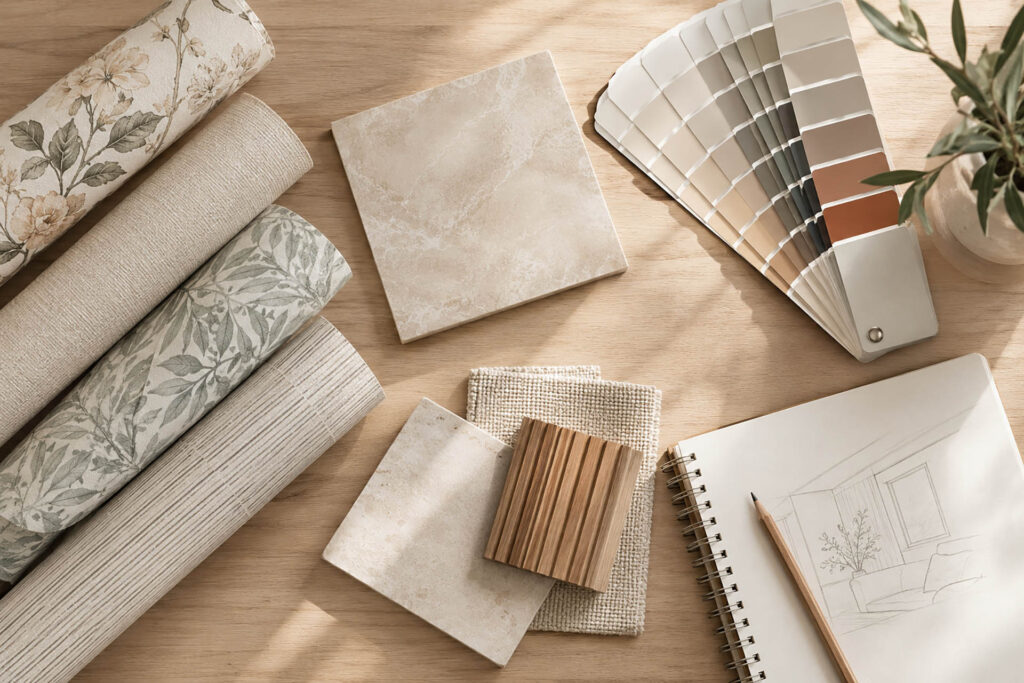
Living rooms usually provide one of the widest ranges of wallpaper possibilities.
Because these spaces are normally relatively dry and stable, clients can consider non-woven wallpaper, designer wallcoverings, murals, grasscloth, textile materials, metallic finishes, and many other specialty products.
One of the main considerations is scale.
A large room can often support a stronger pattern or larger repeat that might overwhelm a smaller space. In other projects, a subtle wallcovering across several walls creates a more complete result than limiting wallpaper to a single accent wall.
Natural grasscloth can be particularly effective in living rooms because directional light reveals the woven fibers, tonal movement, and natural variation of the material.
But natural grasscloth should not be selected with the expectation that every panel will look identical.
Visible seams, differences in fiber density, tonal variation, and irregularity are often part of the material itself rather than installation defects.
For clients considering this category, our Grasscloth & Natural Fiber Installation page explains more about these specialty materials.
Bedrooms often allow more emphasis on atmosphere, texture, and visual softness than on maximum durability.
Non-woven wallcoverings can work particularly well because they are available in an enormous range of patterns and textures while often remaining practical for professional installation.
Textile-look surfaces, natural fibers, and premium designer wallcoverings can also create a softer feeling than harder architectural finishes.
Behind a bed, pattern positioning deserves special attention.
A strong central motif can look excellent when the layout is planned around the headboard. Poor planning can leave the most important part of a design hidden behind furniture or awkwardly divided at the center of the wall.
Bedrooms are also one of the spaces where clients sometimes compare wallpaper with limewash, concrete-style finishes, or Venetian plaster.
The visual effect is very different.
Wallpaper introduces pattern, printed design, textile character, or natural fiber. Decorative plaster creates movement and texture directly on the wall.
Neither is automatically better. They simply create different interiors.
Children’s rooms require a balance between appearance, durability, and how long the design is expected to remain relevant.
Parents often begin with animals, maps, murals, bold colors, or playful patterns.
We also consider:
Washability
Resistance to routine contact
Furniture placement
Wall condition
How easily the room may need to change as the child grows
A highly specific nursery design may be replaced relatively quickly. A more neutral wallcovering can often remain appropriate much longer.
Peel & stick wallpaper is frequently marketed for children’s rooms because it appears easy to install and remove.
In practice, however, “removable” does not mean “forgiving.”
Not necessarily.
Peel & stick products are often presented as simple DIY materials because they do not require traditional wallpaper adhesive.
But the wall itself becomes extremely important.
Many peel & stick products are relatively stiff. Small humps, depressions, drywall texture, poor patches, or uneven corners can affect the ability to keep both the pattern and seams aligned.
Traditional non-woven wallpaper may sometimes be more forgiving because the installer has greater ability to position and adjust the material during installation.
Peel & stick can also be difficult when:
The wall has texture
Corners are not straight
The adhesive grabs aggressively
The material stretches
The product has a large repeat
Panels are very wide
The substrate was not prepared correctly
For more information, see our Peel & Stick Wallpaper Installation page.
The key point is simple:
A product being removable does not automatically make it easier to install well.
A powder room and a full bathroom should not automatically be treated as the same environment.
Powder rooms are often excellent places for wallpaper because they typically do not experience the same steam and moisture levels as bathrooms with showers or tubs.
They are also small enough that clients can use patterns that might feel too intense in a larger room.
Full bathrooms require more careful evaluation.
Important considerations include:
Ventilation
Proximity to direct water
Wall condition
Material construction
Manufacturer specifications
Adhesive requirements
Wallpaper should not automatically be treated as a waterproof surface.
Certain vinyl wallcoverings may offer greater resistance to moisture and cleaning, but the exact product and manufacturer requirements still matter.
Natural materials such as grasscloth generally require more caution in rooms where humidity changes significantly.
Our article on wallpaper in small bathrooms discusses this application in more detail.
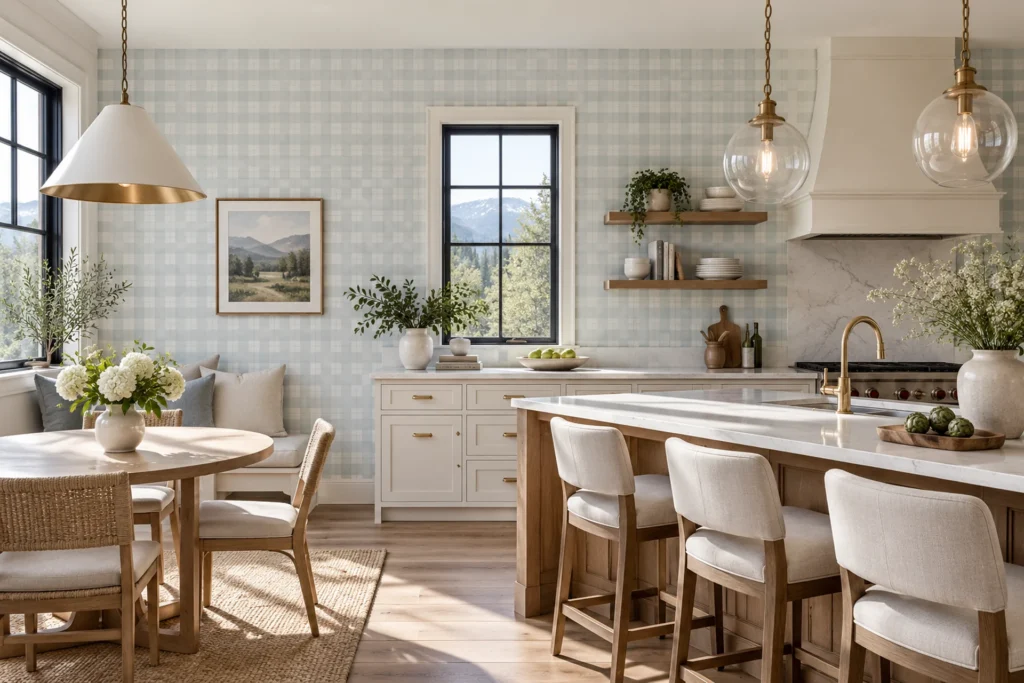
Dining rooms are generally suitable for a wide range of quality wallcoverings.
Kitchens require more selective placement.
Wallpaper can work extremely well in:
Breakfast areas
Dining zones
Feature walls
Walls away from direct cooking exposure
Pantry or transition spaces
Areas immediately exposed to grease, repeated splashing, steam, or direct water should be evaluated differently.
The question should not simply be:
“Can wallpaper go in a kitchen?”
The better question is:
What will this particular wall actually be exposed to?
That distinction is much more useful when choosing a material.
Hallways and staircases often experience more contact than homeowners expect.
Hands, bags, furniture, pets, children, and general traffic all affect the wall surface.
Durability therefore becomes an important consideration.
The installation itself can also become significantly more complex because stairways often include:
High walls
Long drops
Sloped ceilings
Multiple corners
Doors
Landings
Interrupted wall sections
Long sightlines
Pattern layout becomes especially important.
A wallpaper that looks simple on a small sample may require substantial planning once the pattern has to continue through several connected walls.
We have a separate guide on choosing wallpaper for a stairwell for clients considering this type of project.
Home offices have become one of the rooms where clients are increasingly willing to make stronger design choices.
Wallpaper, grasscloth, murals, limewash, and concrete-style decorative finishes can all work particularly well here.
One reason is visibility.
A home office often has a primary wall behind a desk that becomes the visual background for daily work, meetings, and video calls.
Grasscloth can add depth without introducing a strong repeating pattern.
Dark designer wallpaper can create a more architectural environment.
Murals can create a focal wall.
And in modern, loft, or minimalist interiors, clients increasingly compare wallpaper with concrete or microcement-style finishes.
Enjoy The Wall also provides decorative plaster finishes, so we can look at the room and desired result rather than automatically treating wallpaper as the only option.
Basements deserve additional attention because the wall environment may differ from the floors above.
Before installing wallpaper, it is important to understand whether there have been:
Moisture problems
Previous wall repairs
Foundation movement
Significant temperature changes
Unresolved substrate issues
Wallpaper should never be used simply to conceal an active problem.
Once the substrate is stable and properly prepared, many basements can use the same wallcovering categories as the rest of the home.
Lighting also matters.
Because basements often receive less natural light, texture, contrast, and pattern scale can influence the room much more strongly.
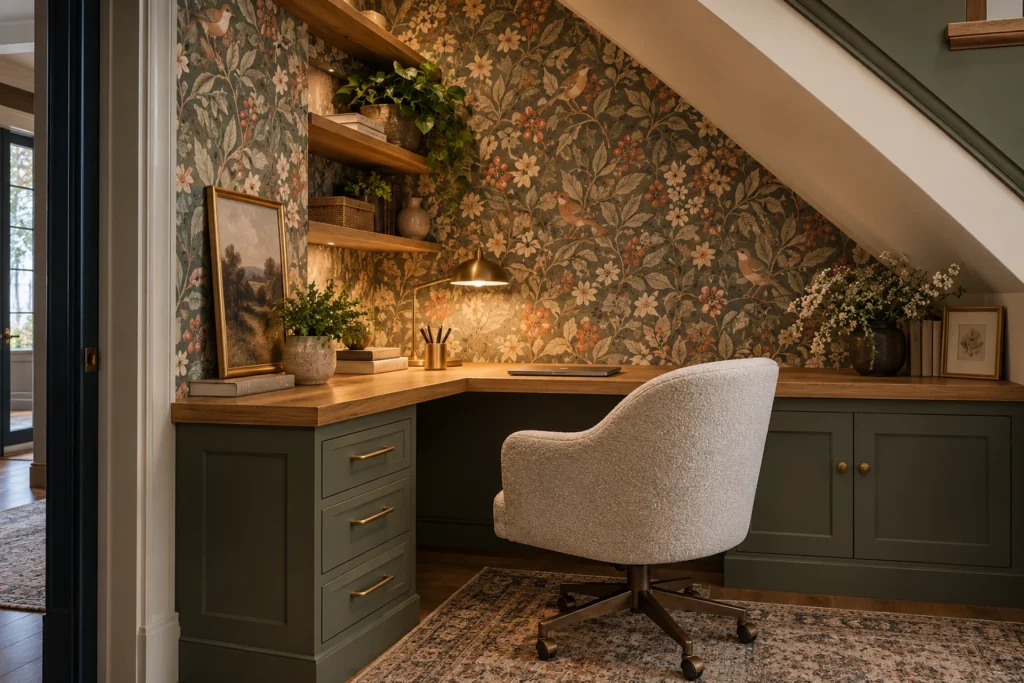
Wallpaper follows the wall more closely than many homeowners expect.
Drywall defects that are barely visible under flat paint may become much more noticeable once wallpaper is installed, especially when directional light crosses the surface.
Preparation may involve:
Cleaning
Sanding
Patching
Skim coating
Repairing damaged drywall
Sealing
Priming
The correct process depends on the wall and the selected wallcovering.
Thin materials and reflective surfaces can reveal defects very easily.
Some heavier or textured wallcoverings are more forgiving, but they should not be treated as a substitute for proper substrate preparation.
Our Wallpaper Removal & Wall Preparation page covers this part of the installation process in more detail.
Wall preparation is not merely an optional cosmetic step.
Colorado has several environmental conditions worth considering during wallcovering projects.
The climate is dry, sunlight can be strong, and indoor temperatures can change considerably between seasons.
During installation and adhesive curing, stable interior conditions are preferable.
Extremely cold interiors, overheated rooms, or significant temperature swings can create unnecessary variables during the installation process.
Strong sunlight is also worth considering over the long term.
Like many interior materials, wallpaper can gradually change when exposed to UV light.
That becomes especially relevant if a wall needs to be repaired several years later.
A replacement strip may come from another production batch, while the material already installed on the wall may have experienced years of sunlight exposure.
Even when the pattern name is identical, a perfect visual match is not always guaranteed.
For that reason, keeping leftover wallpaper from the original installation is often useful.
Natural grasscloth is one of the wallcoverings most frequently misunderstood by clients seeing it installed for the first time.
It is not intended to look perfectly uniform.
Variation may occur in:
Fiber thickness
Color
Weave
Texture
Panel appearance
Seams may remain visible.
Those characteristics are often exactly what make genuine grasscloth attractive.
Trying to make a natural material look like machine-printed vinyl removes much of the reason for choosing it.
Clients who want a very uniform grasscloth appearance may prefer a vinyl or printed grasscloth-look wallcovering instead.
For additional installer-focused discussion, see our article about the challenges of installing grasscloth wallpaper.
We occasionally test unusual material ideas because experiments help us understand how different surfaces behave.
That does not mean every technically possible experiment becomes a client recommendation.
For example, we have tested whether natural grasscloth can be coated with a clear protective finish.
Physically, it can be done in some situations.
But that is different from asking whether it should be done.
Once natural grasscloth is heavily sealed, much of its original visual character changes.
The fibers reflect light differently. The tactile quality changes. Tonal variation becomes less subtle. The surface can begin to look more like a coated manufactured product.
In other words, the treatment may improve one characteristic while removing much of what made the natural material desirable in the first place.
That is why we distinguish between:
Something that is technically possible
Something we have tested
Something supported by a manufacturer
Something repeatedly proven in the field
Something we are comfortable recommending to a client
Manufacturer specifications remain the primary technical reference for a specific wallcovering.
Wallpaper is not the only option for creating a feature wall.
Some clients initially contact us about wallpaper and then compare it with limewash, decorative concrete, microcement-style finishes, or Venetian plaster.
Wallpaper can provide:
Printed pattern
Artwork
Natural fibers
Textile effects
Precise repeating design
Murals
Specialty designer surfaces
Decorative plaster can provide:
Seamless surfaces
Organic movement
Architectural texture
Hand-created variation
Localized repair options in many systems
Repairability is an important difference.
Replacing a single wallpaper strip years after the original installation can sometimes be difficult because of dye-lot differences, discontinued material, or gradual color change from sunlight.
With many decorative plaster systems, an experienced finisher may be able to reopen a localized area, repair the substrate, and recreate or blend the surrounding texture.
We have encountered exactly that type of situation during real projects.
Neither category is universally better.
For a detailed comparison, see Wallpaper vs. Decorative Plaster.
You can, but with expensive or specialty materials, discussing the project before ordering can help prevent expensive mistakes.
An installer may identify issues involving:
Roll width
Roll length
Pattern repeat
Panel configuration
Dye lots
Required quantity
Wall preparation
Product limitations
Installation sequence
Manufacturer specifications
This becomes especially important with murals, natural materials, specialty wallcoverings, and large-repeat designer products.
A consultation can also help determine whether the wallpaper you like is suitable for the wall where you intend to use it.
We discuss this in more detail in How a Wallpaper Consultation Saves You Money.
There is no universal percentage that works for every project.
Required quantity depends on:
Roll dimensions
Pattern repeat
Wall dimensions
Ceiling height
Room geometry
Windows and doors
Layout
Installation method
A large pattern repeat can generate significantly more waste than a small repeat.
Murals and panel sets must be calculated differently from standard rolls.
Rooms with unusual architecture may also require additional material because usable drops cannot always be moved freely between wall sections.
Quantity should therefore be calculated from the actual product specifications and project dimensions rather than from square footage alone.
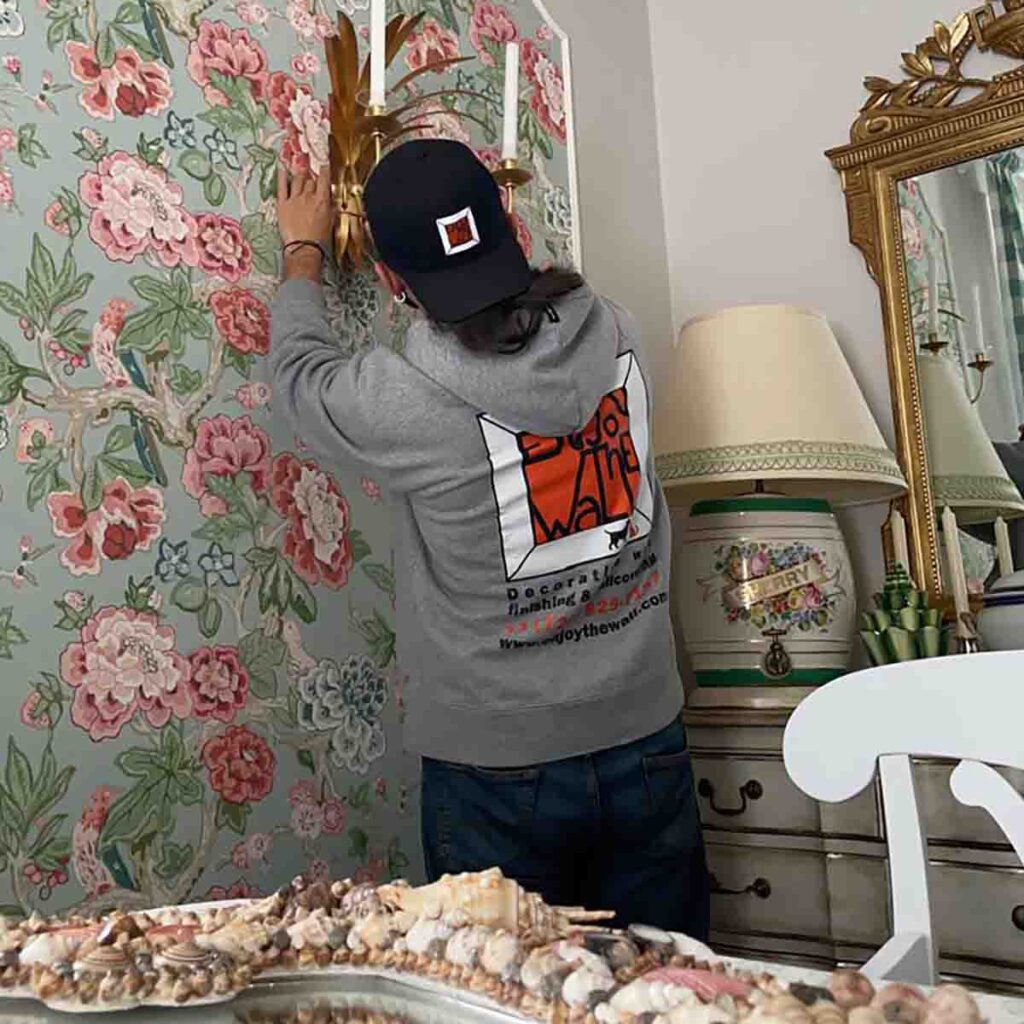
No.
Price and installation behavior are not directly proportional.
Some premium designer wallcoverings are exceptionally well manufactured and predictable to install.
Others intentionally use:
Natural fibers
Handmade printing
Metallic surfaces
Specialty inks
Unusual substrates
Those characteristics may make the finished product beautiful while also requiring more installation skill.
At the same time, a reasonably priced non-woven wallcovering from a reputable manufacturer may install very well.
And an inexpensive peel & stick product can sometimes be surprisingly difficult because of stiffness, dimensional instability, poor trimming characteristics, or aggressive adhesive.
We prefer evaluating the specific material rather than making assumptions based only on price.
Our recommendations continue to evolve because every project adds information.
Kris A. and the Enjoy The Wall installation team work with different manufacturers, wall conditions, adhesives, substrates, patterns, and specialty materials.
Sometimes two wallcoverings that look almost identical behave completely differently during installation.
Sometimes manufacturer instructions confirm exactly what we expect.
Sometimes a specific product introduces an installation issue that would never be obvious from a small sample.
And sometimes we deliberately test an unusual idea simply to understand the material better.
The important part is separating experimentation from recommendation.
There is a meaningful difference between:
“We were able to do this once.”
and
“This is a method we would confidently recommend for a client project.”
That distinction matters in specialty wall finishing.
Not every wallpaper project requires professional installation.
A simple wall with a forgiving material can sometimes be a reasonable DIY project.
The difficulty increases quickly when the project involves:
Expensive wallpaper
Large pattern repeats
Grasscloth
Murals
Textile wallcoverings
Metallic surfaces
High walls
Staircases
Ceilings
Complex corners
Poor wall conditions
Commercial vinyl
Type II wallcoverings
Designer materials
In those situations, an installation mistake may damage material that is expensive, difficult to replace, or no longer available.
Professional installation becomes particularly valuable when the cost of the wallcovering itself is significant.
The best wallpaper choice is rarely based on pattern alone.
Consider the room, the material, the wall, and the installation method together.
A few practical rules apply across most projects:
Start with the design you like, then evaluate whether the material suits the room.
Do not underestimate wall preparation.
Natural materials should be expected to look natural.
“Removable” does not mean “easy.”
Bathrooms and kitchens should be evaluated by actual exposure conditions.
Pattern layout matters before installation begins.
Manufacturer requirements matter.
Keeping leftover wallpaper can make future repairs easier.
Specialty or expensive wallcoverings are worth discussing with an installer before ordering.
There is no single wallpaper type that is best for every living room. Non-woven wallpaper, grasscloth, murals, textile wallcoverings, vinyl, and premium designer materials can all work well depending on the room, wall condition, lighting, and the effect you want to create.
Living rooms usually give homeowners more freedom because they are relatively dry spaces with less direct exposure to water or heavy traffic. Large rooms can often support bigger patterns or stronger designs, while textured wallcoverings can add depth without making the room feel visually busy. Before recommending a material, we also consider direct sunlight, furniture placement, wall preparation, and how visible seams or natural variation may be.
Clients considering natural materials can review our Grasscloth & Natural Fiber Installation page for more detail about panel variation, seams, and material behavior.
Not necessarily. Peel & stick wallpaper eliminates traditional paste, but that does not automatically make the installation easier or more forgiving.
Many peel & stick products are relatively stiff and begin gripping the wall quickly, which can make repositioning difficult. Wall texture, small drywall defects, uneven corners, and large pattern repeats can make alignment noticeably harder. Traditional non-woven wallpaper often gives the installer more control because the material can usually be positioned and adjusted while the adhesive remains workable.
For this reason, we evaluate peel & stick based on the specific product and wall condition rather than assuming it is the easiest option. Our Peel & Stick Wallpaper Installation page explains this material category in more detail.
Yes, wallpaper can be installed successfully in many bathrooms, especially powder rooms. In bathrooms with showers or tubs, the decision depends more heavily on ventilation, direct water exposure, wall condition, and the specifications of the selected wallcovering.
A powder room normally experiences much less humidity than a full bathroom and can be an excellent location for a bold pattern. In a full bathroom, we pay closer attention to steam, areas near sinks and showers, and whether the manufacturer considers the material appropriate for that environment.
For a more specific discussion of this application, see our article on wallpaper in small bathrooms.
Wallpaper can visually reduce some minor imperfections, but it should not be used to hide significant wall defects. The smoother and more consistent the substrate is, the better the finished installation will normally look.
Thin wallpaper, metallic surfaces, and materials viewed under strong directional light can reveal drywall joints, patches, sanding marks, or texture that were barely noticeable before installation. Some heavier or textured wallcoverings are more forgiving, but they do not replace proper wall preparation.
Depending on the project, preparation may include sanding, patching, skim coating, sealing, or priming. Our Wallpaper Removal & Wall Preparation page covers this part of the process in more detail.
Yes. Visible seams and panel-to-panel variation are normal characteristics of many natural grasscloth wallcoverings and are not automatically installation defects.
Natural fibers can vary in thickness, weave, color, and density, so adjacent panels may not look identical even when installed correctly. Lighting can make those differences more noticeable, particularly when sunlight or directional artificial light crosses the wall. Clients who want the perfectly uniform appearance of printed wallpaper may prefer a vinyl or printed grasscloth-look material instead. Genuine grasscloth is usually selected precisely because of its natural texture and variation.
You can, but contacting an installer before ordering is often useful, particularly with expensive, specialty, grasscloth, mural, or large-repeat wallcoverings. A short review before purchase can prevent problems involving quantity, layout, wall preparation, or product suitability.
Wallpaper quantity cannot always be calculated accurately from square footage alone. Roll width, roll length, ceiling height, pattern repeat, mural panel configuration, doors, windows, and room geometry can all affect how much material is actually required.
We discuss this in more detail in How a Wallpaper Consultation Saves You Money.
There is no universal percentage of extra wallpaper that works for every project. The required quantity should be calculated from the actual wall dimensions together with the specifications of the selected product.
A wallpaper with a large pattern repeat may create significantly more waste than one with a small repeat. Murals, panel sets, unusually tall walls, staircases, and rooms with complicated geometry also need to be calculated differently from standard straight walls. When possible, it is also useful to retain some material from the original production batch after installation for potential future repairs.
Sometimes, but replacing one strip years later does not guarantee a perfect visual match. Even if the same wallpaper is still available, dye-lot differences and changes to the material already on the wall can make the replacement noticeable.
Colorado sunlight is particularly relevant because prolonged UV exposure can gradually alter the appearance of many interior materials. The existing wallpaper may therefore look slightly different from a new roll several years later. This is one reason we recommend keeping leftover material from the original installation whenever possible. With discontinued products, having those original remnants can become especially important.
No. Wallpaper price does not reliably indicate how easy the material will be to install or how appropriate it is for a particular room.
Premium wallcoverings may use natural fibers, handmade printing, metallic surfaces, specialty inks, textiles, or unusual substrates. Those characteristics can produce a beautiful finished wall while simultaneously making installation more technically demanding. At the same time, a reasonably priced non-woven wallpaper from a good manufacturer may behave extremely well during installation. We prefer evaluating the specific product rather than judging installation quality by price alone.
Yes. Enjoy The Wall installs wallcoverings that have already been purchased by homeowners, interior designers, architects, builders, general contractors, and commercial clients.
Before installation, we still review the material, available quantity, wall condition, manufacturer specifications, pattern layout, and any preparation requirements that may affect the project. With specialty materials, murals, grasscloth, commercial vinyl, or expensive designer wallcoverings, reviewing those details before installation can prevent avoidable problems once work begins.
Once the wallpaper is chosen, the next step is making sure the design, room conditions, and installation details all work together before the project moves forward.
+1 (720) 825-7157
Proudly working with clients statewide.
If you are still selecting wallpaper, send us the information you already have.
Helpful details include:
Project location
Room and wall dimensions
Photos of the existing walls
Wallpaper manufacturer
Product name or link
Pattern or mural information
Desired installation timing
Whether the wallpaper has already been purchased
The earlier we understand the material and wall conditions, the easier it is to identify potential preparation, quantity, layout, or installation issues before they become expensive problems.
Explore Wallpaper & Wallcovering Services · All Services
For Interior Designers, Architects & Builders · View Recent Projects

Find wallpaper, decorative plaster, brands, guides, FAQs and blog articles.