
Home » Wallcovering & Wallpaper Installation » Wallpaper installation Golden Colorado
A beautiful wallpaper installation depends on more than the wallpaper itself. Wall geometry, surface preparation, trimming method, seam technique, pattern alignment, and the number of architectural obstacles all affect the finished result.
On this residential project in Golden, Colorado, the Enjoy The Wall installation team worked with FAYCE Textiles LINE – Muted Teal, a 30-inch-wide untrimmed non-woven wallpaper. The laundry room included doors, casings, built-in cabinetry, and multiple areas requiring precise cutting, while the wall itself had to be prepared before installation to give the pattern a stable, predictable surface.
For projects like this, our professional wallpaper installation in the Denver metro area is not limited to hanging wallpaper. The installation starts with understanding the material, evaluating the wall, and determining what preparation and seam method the product actually requires.
This Golden project is a good example of why those steps matter.
This was a residential laundry room installation in Golden using a designer wallcovering that required more technical work than a typical pre-trimmed wallpaper.
| Project detail | Specification |
|---|---|
| Location | Golden, Colorado |
| Room | Laundry room |
| Wallpaper | FAYCE Textiles LINE – Muted Teal |
| Material | Non-woven fibre |
| Roll width | 30 inches |
| Format | Untrimmed continuous yardage |
| Finished pattern width | Approximately 27 inches |
| Seam method | Overlap double cut |
| Wall preparation | Completed by Enjoy The Wall |
| Main challenges | Wall geometry, trimming, seams, doors, casings, built-ins, multiple precision cuts |
Homeowners looking specifically for local service can also see our wallpaper installation services in Golden, Colorado.
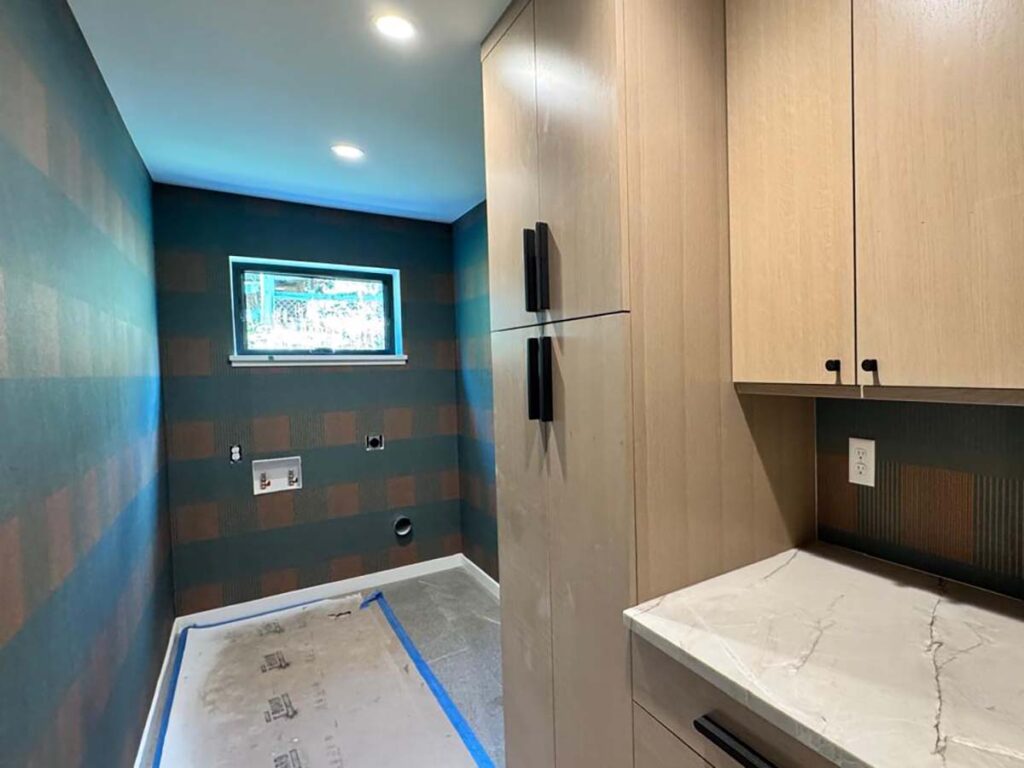
FAYCE Textiles is an American design studio founded by designer and illustrator Kim Rosen.
The LINE collection reflects the hand-drawn quality of Rosen’s work rather than the perfectly mechanical geometry found in many digitally generated patterns. Muted Teal combines an intentionally loose line structure with a soft, understated color palette.
The wallpaper version differs from the fabric version of the same design.
For this project, we were working with the wallpaper, not the textile:
That untrimmed format is important because the finished seam is created by the installer rather than arriving as a factory-finished edge.
This is one reason products like this belong in the category of designer wallpaper installation rather than being treated like an ordinary pre-trimmed residential roll.
Untrimmed wallpaper requires the installer to create the finished seam on site.
With factory-trimmed wallpaper, the manufacturer has already established the finished edges. Adjacent panels are normally positioned so those prepared edges meet according to the product’s installation instructions.
FAYCE LINE – Muted Teal arrived differently.
The edges were left untrimmed, which gave our installers control over where the final seam would be created.
For this project, the wallpaper was installed using an overlap double-cut method.
The panels were positioned with a controlled overlap, aligned to the pattern, and then cut through on the wall so the excess material could be removed and the two newly created edges could meet cleanly.
That method provides a high degree of seam control, but only when the wall underneath is suitable for the process.
It is not simply a matter of placing one strip over another and running a knife through it.
The installer has to control:
The seam is created as part of the installation.
Our team prepared the wall before installing the FAYCE wallpaper because the finished result depended on having a controlled surface.
A wallpaper can be beautifully printed and professionally manufactured, but it still follows the geometry of the wall underneath it.
This becomes particularly important when the installation involves precise pattern alignment and double-cut seams.
Before installation, we corrected the surface so the wallpaper would not have to compensate for defects that should have been addressed at the substrate level.
When more substantial correction is required, we treat wallpaper removal and wall preparation as part of the installation system rather than a separate cosmetic step.
This is one of the most difficult wallpaper issues to explain until a client sees it on the actual wall.
A wall can look completely flat to the eye and still contain a bow, dip, belly, or gradual deviation that affects wallpaper alignment.
When we place a long 6- to 8-foot level or straightedge against a wall, conditions that are almost invisible from across the room can become obvious.
There may be a gap behind the straightedge.
Another section may push outward.
The wall may gradually move in or out across several feet.
To someone looking at a painted wall, that difference may appear insignificant.
To an installer trying to make two parts of a wallpaper pattern meet precisely across a seam, it can matter a great deal.
Wallpaper is installed onto a three-dimensional surface.
If one panel travels over a slight outward bow while the neighboring panel crosses a flatter area, the effective path of the two pieces is no longer identical.
That can influence where the pattern reaches the seam.
Some wallcoverings offer limited flexibility during installation. Others are comparatively dimensionally stable.
But wallpaper is not an elastic sheet that can always be stretched or compressed until every architectural problem disappears.
Trying to force a material beyond the amount of movement it naturally allows can create another problem:
This is why our installers prefer to solve significant geometry problems at the wall whenever practical rather than ask the wallpaper to compensate for them.
For a broader discussion of surface conditions, see our guide to installing wallpaper on textured and imperfect walls.
The LINE design has an intentionally hand-drawn appearance, but that does not eliminate the need for accurate alignment.
The reason we did not encounter major pattern problems on this installation was not because the wall could be ignored.
It was the opposite.
The wall had been prepared before the wallpaper was installed.
That gave our installers a more predictable surface for positioning the material, setting the overlap, and creating the double-cut seams.
This is an important distinction.
People sometimes assume that if a wallpaper has an organic or hand-drawn pattern, alignment becomes unimportant.
That is not necessarily true.
The eye may tolerate certain natural variations within the artwork, but a misplaced seam, distorted repeat, or accumulated alignment error can still be visible.
Preparation reduces the number of variables the installer has to fight during hanging.
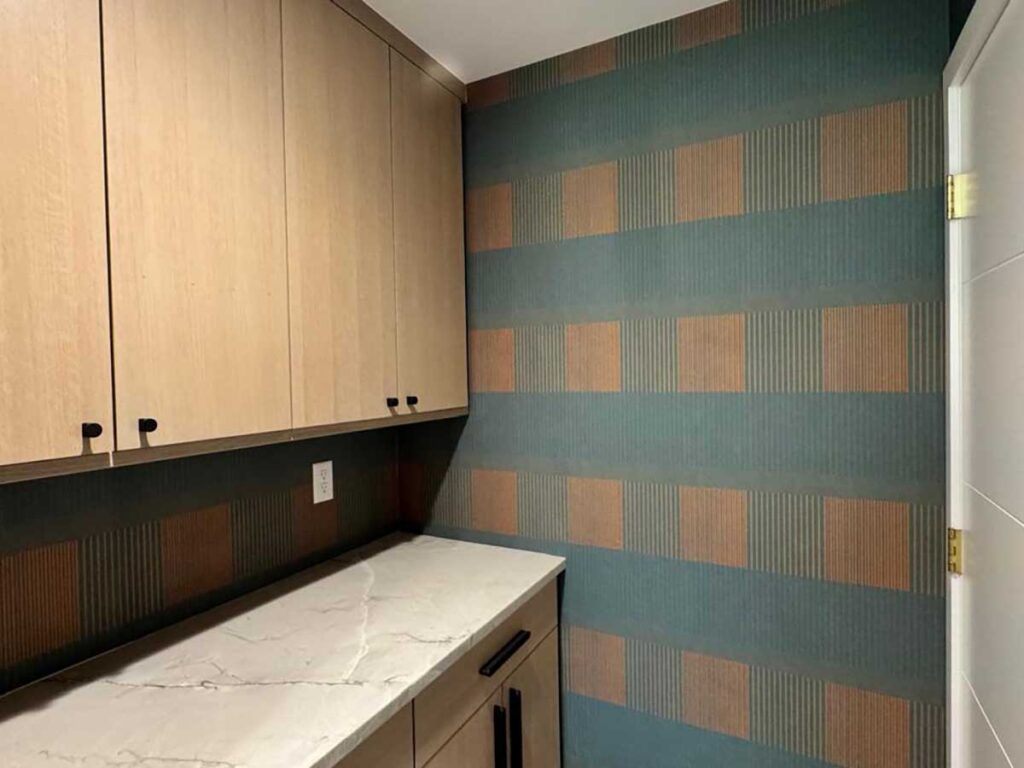
For this FAYCE installation, our installers created the finished seams on the wall using overlap double cutting.
The basic principle is straightforward.
Two neighboring panels overlap each other. Once the pattern and position are correct, both layers are cut along the same line. The narrow waste strips are removed, and the newly created edges are brought together.
The result is a custom-cut butt seam.
The difficult part is not understanding the concept.
The difficult part is executing it consistently across the entire installation while maintaining pattern alignment and protecting the substrate underneath.
Wall condition therefore matters.
If the surface is unstable, heavily textured, poorly repaired, or otherwise unsuitable, creating a precise seam becomes more difficult.
Seams can also appear differently depending on the material, light, wall color, print, and construction. We explain those variables in more depth in our article on why wallpaper seams can become visible.
The broad wall areas were only part of this project.
A laundry room can contain far more cuts per square foot than a simple bedroom feature wall.
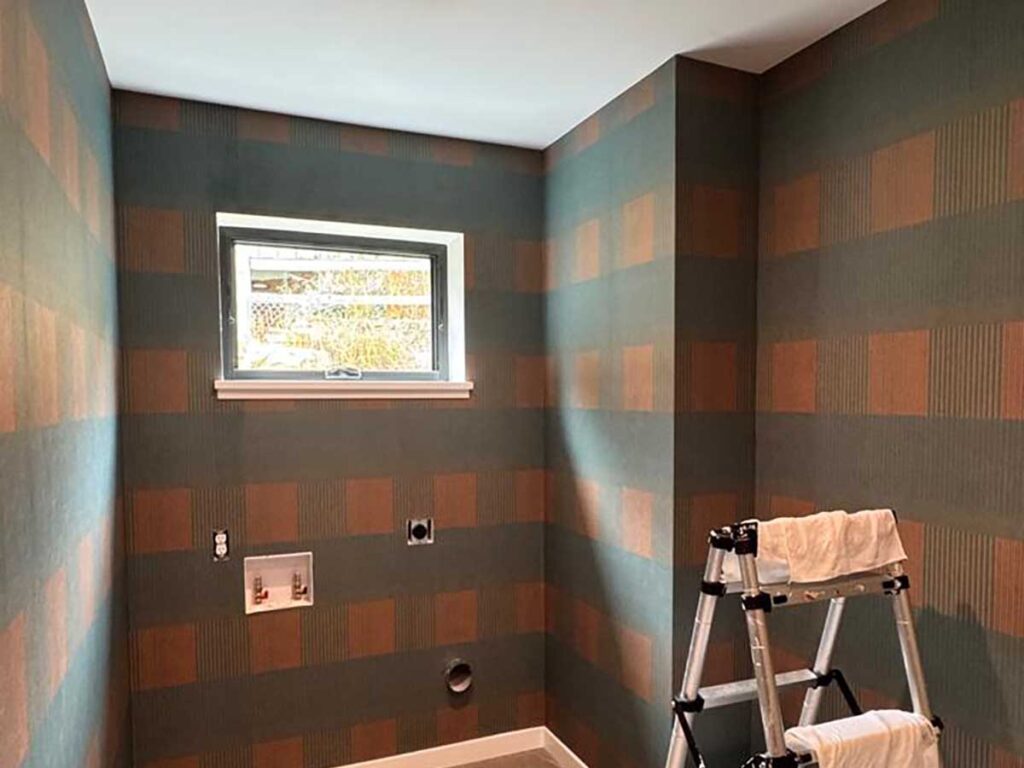
On this Golden installation, our team had to work around:
Every interruption changes the workflow.
A full-height wallpaper panel on an open wall can be positioned and controlled as one continuous piece.
A panel that has to interact with cabinetry or trim may require several cuts while the installer is also maintaining the pattern position and controlling the material.
Existing homes are rarely geometrically perfect enough to rely on theoretical dimensions.
A casing may not be perfectly vertical.
A cabinet may not be perfectly parallel to the wall.
A ceiling or countertop may change slightly from one side to the other.
For that reason, final cuts often have to respond to the actual conditions in front of the installer.
The goal is to make the wallpaper fit the architecture that exists — not the dimensions we wish existed.
Kris A., Co-Founder, Lead Installer & Design Consultant at Enjoy The Wall and a member of the Wallcovering Installers Association (WIA) and Interior Design Society (IDS), approaches projects like this by separating the variables that can be corrected before installation from those that must be managed while the material is on the wall.
That means asking several questions before hanging begins.
Is the substrate sufficiently flat for this product?
Are there wall defects that will interfere with a double cut?
Where should the pattern begin?
How will major pattern elements interact with cabinetry, doors, and trim?
How much material is available?
Where will narrow cuts occur?
Which architectural conditions cannot be changed and therefore need to be managed through layout?
This type of planning is especially useful with untrimmed designer wallcoverings because the installer is creating part of the finished product on site.
The factory supplies the printed material.
The installer creates the final relationship between that material and the architecture.
It can be, provided the actual room conditions are appropriate for the wallcovering.
A laundry room is not automatically the same environment as a shower enclosure or another repeatedly wet surface.
What matters is the actual exposure.
For a wallpaper project in a laundry room, we would consider:
We would not describe an uncoated designer wallpaper as waterproof unless the manufacturer specifically identifies it that way.
At the same time, we would not automatically reject every wallpaper simply because the room contains a washing machine.
The material and the room have to be evaluated together.
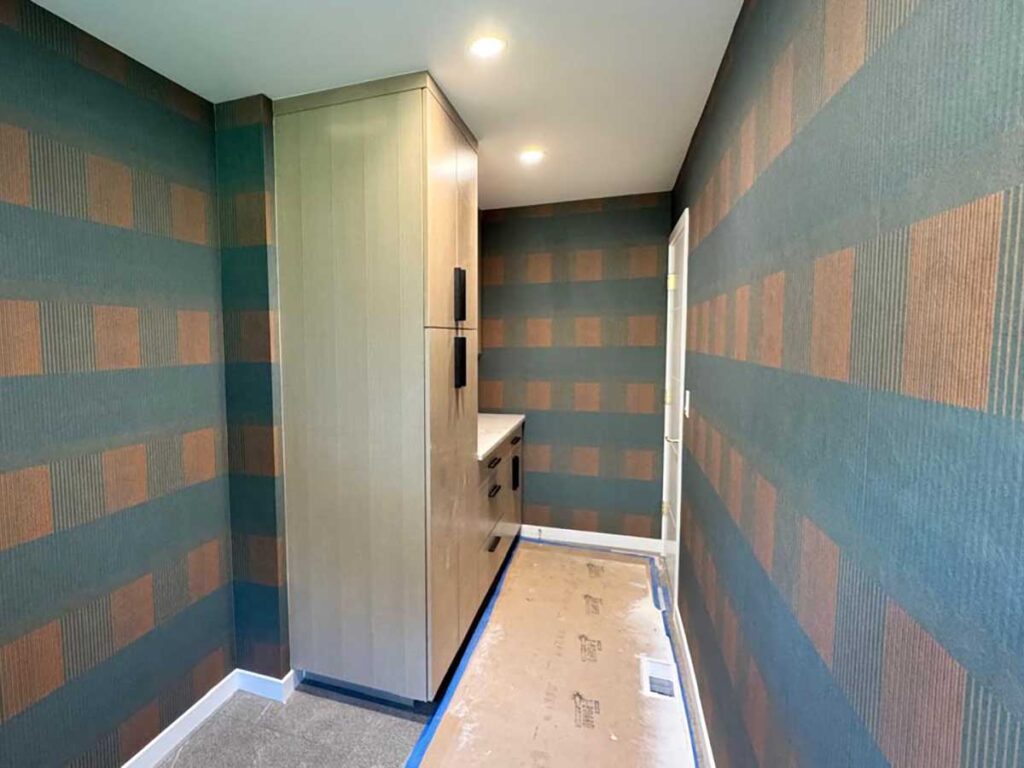
This installation demonstrates why professional wallpaper work cannot be evaluated only by looking at the final pattern.
Several technical decisions were hidden beneath the finished surface.
The wall was prepared before hanging.
The material arrived untrimmed.
The seams had to be created during installation.
The pattern had to remain controlled while the panels were overlapped and cut.
The wallpaper then had to be fitted around doors, casings, cabinetry, and built-in elements without losing the visual continuity of the design.
The finished room may look simple.
The installation process was not.
That difference is common in high-quality wallpaper work: when preparation and installation are done correctly, much of the technical complexity disappears from the finished appearance.
Before installing another untrimmed designer wallcovering such as FAYCE LINE, our team would want to confirm the wall condition, material specifications, available quantity, pattern layout, and architectural obstacles before installation day.
The wall deserves particular attention.
If a long straightedge reveals significant bows or depressions, that information should be considered before the first panel is installed.
The goal is not to make every wall theoretically perfect.
The goal is to understand whether the existing wall geometry is compatible with the wallcovering and the expected finished result.
That decision may change depending on whether the product is a thick vinyl, delicate paper, non-woven wallcovering, grasscloth, textile, or another specialty material.
No. The wallpaper used on this project was supplied untrimmed.
The installer creates the final edges during installation. On our Golden project, that was done using an overlap double-cut method.
Overlap double cutting is a seam technique in which two wallpaper panels overlap and are cut together to create matching finished edges.
After the cut, the waste strips are removed and the newly created edges meet as a butt seam. The method requires careful control of the pattern, wall surface, knife pressure, and material.
Because wallpaper follows the surface underneath it.
A bow, dip, ridge, or depression can influence both the finished appearance and the path the material takes across the wall. That can become especially important when a pattern must align precisely from panel to panel.
One useful method is checking it with a long straightedge or level.
Our installers may use a 6- to 8-foot reference to reveal gradual deviations that are difficult to see with the eye alone. A wall may look fine from several feet away while still having enough movement to affect a demanding wallpaper installation.
Only within the natural behavior of the specific material, and forcing the wallpaper is not a reliable solution to an uneven wall.
Different wallcoverings behave differently. Excessive stretching or compression can distort the print, stress seams, or create other installation problems.
No. A professional double cut should create a clean, controlled seam, but visibility can still depend on the wallpaper, print, lighting, wall preparation, edge condition, and other factors.
The realistic goal is a properly executed seam appropriate for the material, not a promise that no seam can ever be detected under any lighting condition.
Sometimes, but the difficulty depends more on the product construction than the price or designer name.
Untrimmed edges, delicate surfaces, unusual widths, hand-printed materials, natural fibers, and complex seam requirements can all increase installation difficulty. Our article on professional wallpaper hanging explains more of the installation process.
Yes, but built-ins usually increase the number of cuts and transitions the installer has to manage.
The wallpaper must be fitted to the actual cabinetry, trim, and wall geometry while maintaining the intended pattern position.
Yes. Significant preparation requirements should ideally be identified before the wallpaper installation is scheduled.
That allows time to correct the substrate, allow appropriate drying or curing where necessary, and begin installation on a stable surface.
Have questions about FAYCE LINE – Muted Teal or another designer wallpaper project? Contact our team to discuss wall preparation, untrimmed materials, double-cut seams, detailed trimming, or installation in Golden, the Denver metro area, and across Colorado.
We can help you determine the right next step before installation begins.
+1 (720) 825-7157
Proudly working with clients statewide.
Planning a designer wallpaper project in Golden, the Denver metro area, or elsewhere in Colorado?
Enjoy The Wall works with homeowners, interior designers, architects, builders, general contractors, and commercial clients on projects ranging from individual feature walls to specialty and designer wallcovering installations.
Our team can handle wall preparation, layout, untrimmed materials, pattern alignment, precision cutting, and installation around detailed architectural elements.
Explore Wallpaper & Wallcovering Services · All Services
For Interior Designers, Architects & Builders · View Recent Projects

Find wallpaper, decorative plaster, brands, guides, FAQs and blog articles.