Home » Wallcovering & Wallpaper Installation » Wallpaper for stairwell
Stairwells offer some of the most interesting opportunities for wallpaper in residential interiors. Tall walls, dramatic vertical spaces, and views from multiple levels can transform an ordinary staircase into a distinctive architectural feature.
But installing wallpaper in a stairwell is considerably more demanding than covering a standard eight-foot wall. Height, sloped ceilings, difficult access, long wallpaper panels, and limited working space introduce challenges that require careful planning, specialized equipment, and experienced installers.
At Enjoy The Wall, our experience with residential and commercial wallcoverings across Colorado has shown that successful stairwell projects depend on more than choosing an attractive pattern. The material must suit the environment, the walls must be properly prepared, and the installation team must have safe access to the entire surface.
Our professional wallpaper installation services in the Denver metro area include technically demanding spaces such as tall stairwells, multi-level interiors, and walls with complex architectural features.
This guide explains how to choose wallpaper for a staircase, which materials perform best in high-traffic areas, why installation becomes more expensive as wall height increases, and what professional stairwell installation actually involves.
A typical residential wall is approximately eight feet high. The installer can usually access most of the surface with relatively simple equipment, control the wallpaper from top to bottom, and work from a stable, level floor.
Stairwells are different.
A staircase may extend through two floors, creating walls 16 feet tall or higher. The floor beneath the work area is sloped or divided into steps, and there may be no convenient place to position a conventional ladder.
The installer must also work around railings, landings, windows, corners, and changing ceiling heights.
These conditions complicate several essential operations: establishing a vertical reference line, positioning long wallpaper panels, matching patterns, controlling adhesive, smoothing the material, and cleaning the finished surface.
The difficulty becomes even greater when the wallcovering is heavy, delicate, or requires adhesive to be applied directly to the material.
On a conventional wall, one experienced installer may be able to complete many of these operations independently. On a tall stairwell, the same operations can require coordinated work by multiple people.
This is why stairwell wallpaper installation should be evaluated as a specialized project rather than simply another wall measured in square feet.
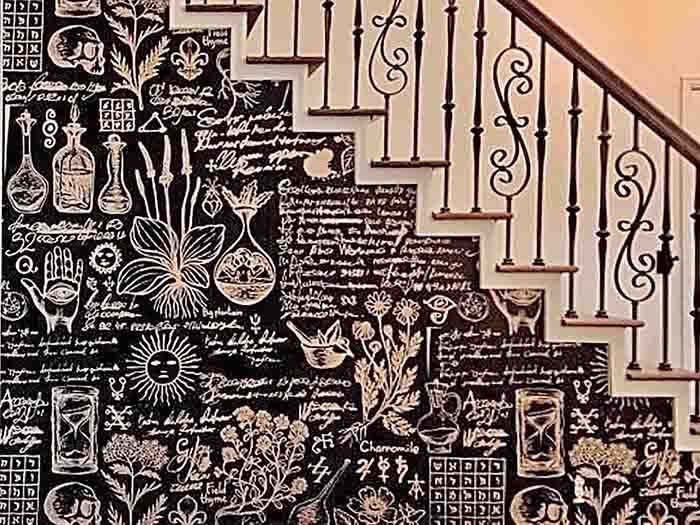
For stairwells exposed to frequent physical contact, durable vinyl wallcovering is generally our preferred choice.
Staircases are circulation areas. People walk past the same surfaces every day, brush against walls with their shoulders, carry luggage or furniture between floors, and sometimes touch the walls for balance.
A wallcovering selected primarily for its decorative appearance may not withstand this type of use.
Quality vinyl wallcoverings offer practical advantages in busy staircases.
Depending on the product, they can provide good abrasion resistance, cleanability, and greater tolerance of routine contact than delicate natural or uncoated materials.
Commercial Type II vinyl is specifically designed for more demanding environments, making it an excellent option for high-traffic corridors, rental properties, hospitality interiors, and certain residential stairwells.
Some heavier or textured vinyl products can also visually reduce the appearance of minor surface irregularities. However, this does not eliminate the need for proper wall preparation.
Even durable commercial vinyl requires a sound, smooth, properly prepared substrate and an installation system compatible with the manufacturer’s specifications.
For more information, see our Vinyl & Type II Wallcovering Installation services.
Non-woven wallpaper can also be an excellent choice, particularly for residential staircases where decorative appearance is a priority.
It is available in a wide variety of designs, including geometric patterns, botanical prints, subtle textures, and contemporary architectural styles.
Many non-woven products use a paste-the-wall installation method, which can provide an important handling advantage when installing long panels at height.
However, non-woven construction alone does not guarantee resistance to scratches, abrasion, or stains. Performance depends on the product’s surface finish and manufacturer specifications.
For areas subject to frequent contact, we generally favor more durable wallcoverings over delicate decorative finishes.
Natural grasscloth can look beautiful in an elegant staircase, but it is not our first recommendation for areas where people frequently touch the walls.
Natural fibers can be vulnerable to abrasion, staining, moisture, and physical damage. Their woven texture may also attract attention from pets, particularly cats.
Unlike many coated vinyl products, natural grasscloth usually cannot be cleaned aggressively without risking changes to its appearance.
We prefer reserving these materials for decorative areas where contact is limited and the homeowner understands their maintenance requirements.
A staircase can still feature natural grasscloth successfully, but the location and expected use should guide the decision.
Peel-and-stick wallpaper is frequently marketed as an easy, inexpensive alternative to traditional wallpaper.
Manufacturers emphasize that it does not require separate adhesive and can often be installed without professional assistance.
Our installation experience leads us to a different conclusion, especially for tall stairwells.
Peel-and-stick material can be difficult to position accurately because the adhesive surface begins attaching to the wall during installation. Unlike traditional wallpaper systems, which may allow more working time for positioning and adjustment, pressure-sensitive adhesive can make repositioning long panels particularly frustrating.
Imagine attempting to control a 12- or 16-foot-long panel while working from an elevated platform. The upper portion must remain properly aligned while the lower portion is supported and prevented from attaching prematurely.
A small positioning mistake near the top can create problems along the entire length.
Removing and repositioning the material can stretch it, distort the pattern, weaken adhesion, or damage the surface.
There is another issue homeowners often overlook: removal.
Peel-and-stick wallpaper is not guaranteed to come off without damage. Depending on the adhesive, paint, primer, and underlying wall condition, removal may pull away paint or damage the drywall surface, requiring additional repairs.
At Enjoy The Wall, we generally view peel-and-stick wallpaper as a temporary decorative option rather than a preferred system for permanent stairwell installations.
For a long-term project, properly installed traditional wallpaper or commercial wallcovering is usually a more predictable investment.
We discuss these limitations in greater detail in Peel and Stick vs. Traditional Wallpaper in the Denver Metro Area.
Installing wallpaper on a two-story staircase requires more than a tall ladder.
Professional installers must be able to access the working surface safely, maintain control of the wallpaper, and move along the wall without constantly interrupting the installation.
Because the staircase itself is sloped, conventional equipment may not provide an appropriate working surface.
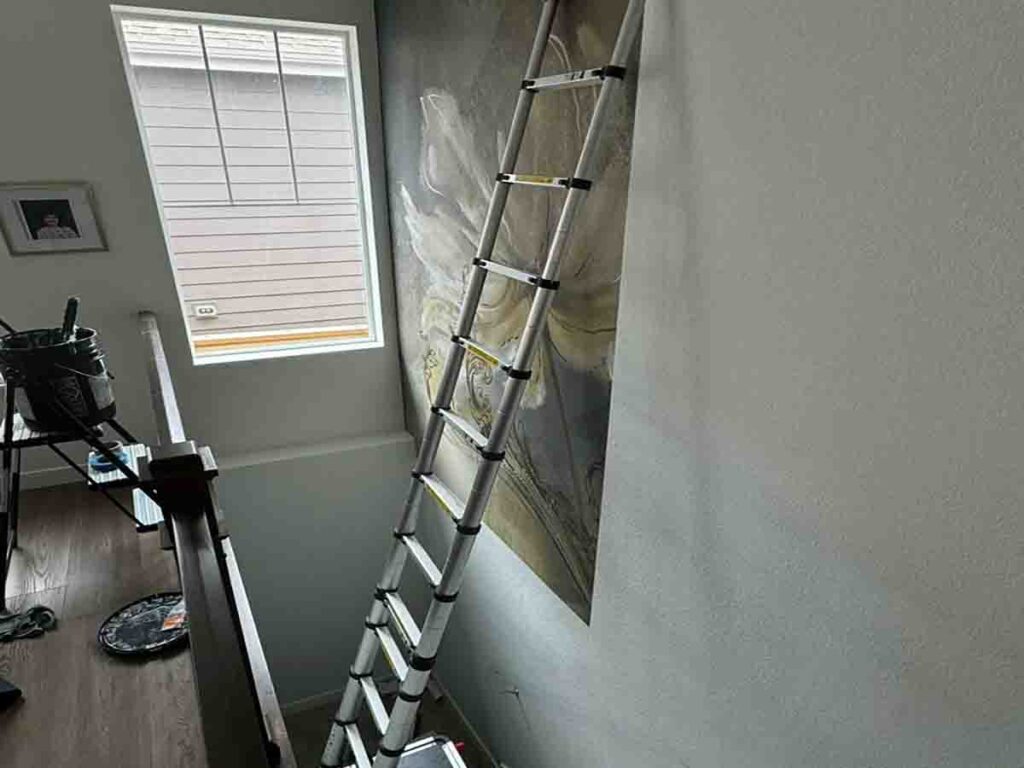
Depending on the geometry of the stairs and the required working height, installers may need specially configured stairwell platforms, adjustable scaffolding, purpose-built support systems, or elevated working decks.
Some installations require specialized L-shaped stairwell platform arrangements or other equipment designed to accommodate changes in elevation.
The objective is to provide a stable working area where the installer can position wallpaper, move tools, check seams, and control the material without balancing on individual stair treads.
For particularly high walls, scaffolding towers or larger access systems may be required.
All equipment must be appropriate for the stair configuration, installed according to the manufacturer’s requirements, and used within applicable safety standards.
This equipment must also be transported to the property, carried into the work area, assembled, inspected, disassembled, and removed after installation.
Those activities are part of the actual labor required to complete the project.
A standard eight-foot wallpaper panel is relatively manageable for an experienced installer.
A 16-foot panel is a different challenge.
The material must remain properly oriented while the installer establishes alignment, positions the upper section, manages the lower section, and works progressively along the wall.
Long panels can fold, twist, stretch, or contact surfaces unintentionally.
When adhesive is applied directly to the wallpaper, handling becomes even more demanding. The material may be heavier and more difficult to control, depending on its construction and installation requirements.
Paste-the-wall systems can simplify certain parts of the process because the installer may handle a dry panel rather than one already coated with adhesive.
Nevertheless, even a dry 16-foot panel requires careful coordination.
Pattern matching becomes especially important. A small alignment error can become highly visible across a tall uninterrupted wall, particularly with geometric designs or strong vertical lines.
A single installer cannot always efficiently manage a long wallpaper panel while simultaneously controlling the upper section, supporting the lower section, preparing materials, and maintaining a clean working environment.
Depending on the wall height and layout, several installers or assistants may be necessary.
One specialist may work from the upper platform to establish alignment and position the wallpaper. Another supports and guides the material below, while additional assistance may be needed for preparing adhesive, supplying tools, cleaning, and managing subsequent panels.
This coordinated process helps prevent damage to expensive wallcoverings and supports more accurate installation.
The additional labor is not simply a matter of convenience. For many tall-wall installations, it is an important part of completing the work safely and effectively.
Stairwell wallpaper installation costs more because height and difficult access reduce installation productivity while increasing labor, equipment, and preparation requirements.
Square footage alone does not tell the full story.
At Enjoy The Wall, an eight-foot wall represents our standard installation height. As wall height increases, the project moves into progressively more demanding installation categories.
| Wall height | Installation considerations |
|---|---|
| 8 feet | Standard wall installation |
| 10 feet | Increased access and handling requirements |
| 12 feet | Greater physical effort and installation complexity |
| 14 feet | High-wall work that may require more specialized access |
| 16 feet | Complex long-panel handling and potentially additional crew members |
| Over 16 feet | Project-specific evaluation of access equipment, scaffolding, labor, and logistics |
These categories describe increasing complexity rather than fixed price multipliers. Actual requirements depend on the staircase geometry, material, pattern, and available access.
The economics are straightforward.
An experienced installer can complete a certain amount of standard wall space during a normal workday. That same installer may complete considerably less square footage when working on a staircase, ceiling, or sloped surface.
The physical demands are different, and more time is spent positioning equipment, managing material, and moving between working locations.
Specialized equipment adds further costs, including transportation, setup, adjustments, and removal.
For this reason, professional wallcovering companies typically evaluate factors beyond wall area when preparing estimates.
The same principle applies to other difficult architectural surfaces.
Wallpaper installation on a sloped attic wall requires different handling and body positioning than installation on a standard vertical wall.
Ceiling installation is more physically demanding still. The installer must control and position material overhead while managing alignment, adhesive, and seams.
The area may be identical to that of a conventional wall, but the time and effort needed to complete it are not.
A professional estimate accounts for these differences rather than treating every square foot as equally difficult.
For broader planning considerations, see our guide to the best wallcoverings for high ceilings.
Tall walls and strong natural light can expose imperfections that might be less noticeable in smaller rooms.
Stairwells frequently contain large, uninterrupted wall sections, making visible seams, uneven surfaces, and substrate defects more apparent.
In Colorado homes, existing drywall texture can also complicate wallpaper installation.
Before hanging wallcovering, the substrate should be inspected for loose paint, damaged drywall, cracks, uneven texture, contamination, and previously applied materials.
Necessary preparation may include repairs, smoothing, sanding, and applying an appropriate wallpaper primer.
A heavy commercial vinyl may help visually disguise some minor irregularities, but it should not be used as a substitute for correcting an unsuitable substrate.
Wall preparation becomes particularly important on very tall stairwells because repairing defects after installation may require rebuilding the same access system used for the original work.
Addressing problems before wallpaper installation is usually more practical than correcting them afterward.
Learn more about our approach to wallpaper removal and wall preparation.
A stairwell is not viewed from one fixed position.
People see the wall while approaching the stairs, climbing, descending, standing on landings, and looking down from the upper floor.
This creates interesting design opportunities, but it also makes wallpaper layout particularly important.
Tall stairwells can accommodate bold designs that might feel overwhelming in smaller rooms.
Large botanical patterns, architectural geometrics, textured finishes, and vertical compositions can emphasize the height of the space.
Vertical patterns can strengthen the sense of height, while carefully selected horizontal or flowing designs can visually connect different levels.
However, the starting point must be planned carefully.
A prominent motif positioned beautifully on the lower floor may look awkward where the ceiling slopes or the staircase reaches the upper landing.
Pattern repeat affects both the appearance and material requirements of the project.
In a tall stairwell, every full-height panel may require substantial additional material to maintain proper pattern alignment.
Large repeats can increase waste, particularly when the wall height changes across the staircase.
Door openings, landings, and sloped ceiling lines can complicate calculations even further.
This is why calculating material based only on the total square footage of a staircase can produce an inaccurate order.
The installer should consider usable panel lengths, roll dimensions, pattern repeat, trimming allowances, and the intended layout.
Our Wallpaper Guide: Sizes, Repeats & Materials Explained covers these considerations in more detail.
Yes. A stairwell can be an excellent location for a large wallpaper mural.
Custom murals can turn tall walls into architectural focal points, especially where the design can be appreciated from both floors.
However, mural installation requires particularly careful planning.
Unlike a repeating wallpaper pattern, a mural usually has a specific composition. The placement of its focal point, individual panels, and visible design elements must be considered before installation begins.
Sloped ceilings, stair landings, railings, and changing wall dimensions may interrupt important parts of the image.
A mural should therefore be evaluated against the actual wall geometry rather than selected solely from a product photograph.
Material construction matters as well. For an area exposed to frequent contact, a durable and appropriately finished mural material is generally more practical than a delicate uncoated print.
Custom mural projects may also require coordination between the printing specifications and the installation layout.
At Enjoy The Wall, we work with both standard wallcoverings and custom printed murals. You can explore our wall mural and custom print installation services for additional information.
A well-planned stairwell installation begins before the wallpaper arrives.
The installation team should understand the geometry of the staircase, the condition of the walls, and the access requirements early enough to identify potential problems.
Material selection, measurements, and equipment planning are closely connected.
A heavy commercial wallcovering installed across a two-story staircase may require a different crew arrangement and handling process than a lightweight paste-the-wall product in a smaller residential stairwell.
Similarly, a large mural with precise image placement may require more detailed layout work than a subtle random-match pattern.
A professional project assessment should consider the wall height, staircase width, landings, available working space, substrate condition, wallpaper construction, pattern repeat, and installation instructions.
It should also determine how necessary access equipment will be brought into the property and whether railings, fixtures, or other architectural elements restrict the working area.
For homeowners, interior designers, and builders, identifying these factors before ordering materials can help prevent costly shortages, scheduling problems, and unnecessary rework.
Stairwell wallpaper installation is more complicated than ordinary wallcovering work because the installer must manage difficult access, longer panels, changing wall geometry, and additional physical demands.
For heavily used staircases, durable vinyl and commercial-grade wallcoverings are generally among the most practical choices. Natural grasscloth is better suited to protected decorative areas, while peel-and-stick wallpaper is not our preferred solution for permanent stairwell projects.
Standard eight-foot walls, two-story staircases, sloped attic surfaces, and ceilings should not be priced as though they require identical labor.
High-quality stairwell installation depends on proper wall preparation, appropriate materials, careful pattern planning, specialized access equipment when necessary, and an experienced installation team.
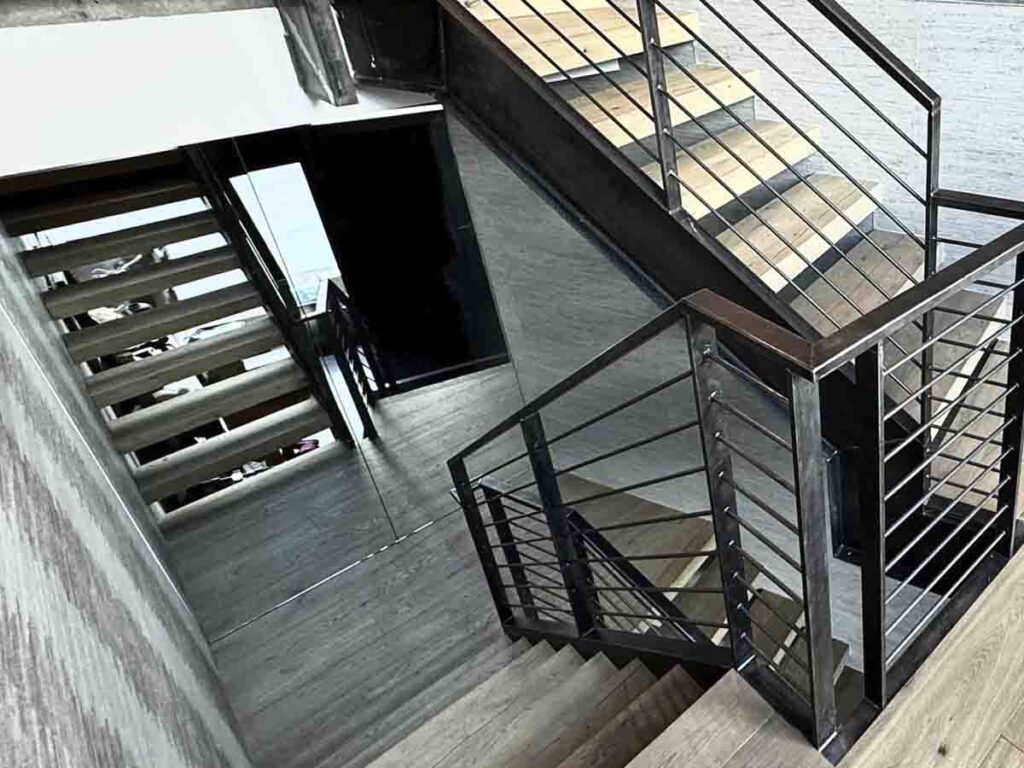
Durable vinyl wallcovering is generally the best choice for a staircase exposed to frequent physical contact. Quality commercial-grade vinyl can provide excellent resistance to routine wear and is often easier to maintain than delicate natural materials. In lower-traffic residential stairwells, suitable non-woven wallpaper may also perform well.
Yes, wallpaper can be installed on walls 16 feet tall or higher. However, installation may require specialized platforms, scaffolding, long-panel handling techniques, and multiple installers. The access plan depends on the staircase geometry and the selected wallcovering.
Stairwell installation requires more labor time, specialized access equipment, and sometimes additional crew members. Installers generally complete less square footage per day when working on tall or difficult surfaces compared with standard eight-foot walls. Equipment transportation, assembly, and removal may also affect the project cost.
Ordinary ladders are not always suitable for tall stairwell installations. Complex staircases may require appropriately configured scaffolding or specialized working platforms that provide stable access. The correct equipment depends on the height, staircase geometry, and work being performed.
Enjoy The Wall generally does not recommend peel-and-stick wallpaper for permanent stairwell installations. Long self-adhesive panels can be difficult to align and reposition, particularly when working at height. Removal may also damage existing paint or drywall surfaces.
Yes, but it is better suited to areas with limited physical contact. Natural grasscloth can be sensitive to abrasion, stains, moisture, and accidental damage. For busy staircases, we usually recommend a more durable alternative.
Some heavy or textured vinyl wallcoverings can make minor surface irregularities less noticeable, but they do not replace proper wall preparation. Damaged drywall, loose paint, excessive texture, and other substrate defects should be addressed before installation.
Yes, but sloped surfaces and ceilings generally require more labor than standard vertical walls. Handling, alignment, access, and the installer’s working position can make these projects significantly more demanding. The cost should reflect the actual installation conditions.
For a complex or tall stairwell, professional measurements and layout planning are strongly recommended before ordering. Pattern repeat, roll width, usable panel length, ceiling slopes, and the position of major design elements can all affect the required quantity.
Have questions about your project or need to discuss specific installation requirements? Contact our team directly — we’re happy to help.
+1 (720) 825-7157
Proudly working with clients statewide.
Planning wallpaper installation for a staircase, two-story entryway, or another difficult-to-access interior wall?
Enjoy The Wall works with homeowners, interior designers, builders, and general contractors throughout the Denver metro area and across Colorado.
Our team can evaluate the wall conditions, recommend suitable wallcovering materials, determine access requirements, and plan the installation around the architecture of your space.
Whether the project involves a residential staircase, a high-ceiling feature wall, or a complex multi-level interior, we focus on achieving a durable, professionally finished result.
Explore Wallpaper & Wallcovering Services · All Services
For Interior Designers, Architects & Builders · View Recent Projects

Find wallpaper, decorative plaster, brands, guides, FAQs and blog articles.